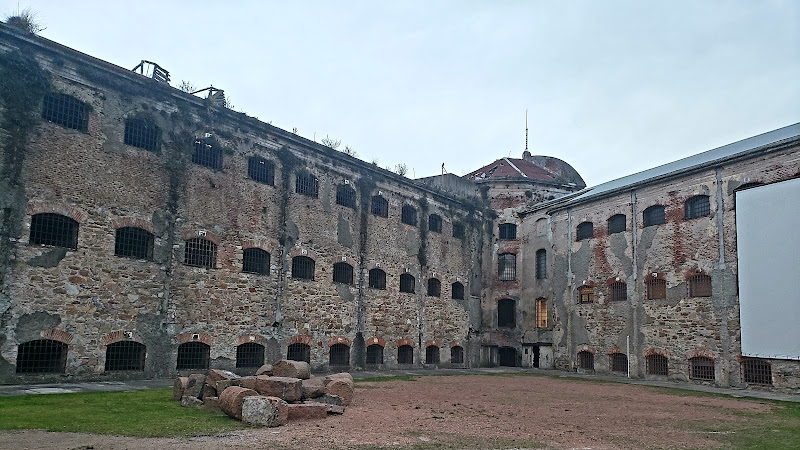
Contemporary Art Space, known locally as Espacio de Arte Contemporáneo (EAC), is Uruguay’s principal public venue for contemporary visual art at Arenal Grande 1930, on the Cordón–La Aguada edge of Montevideo, Montevideo Department, Uruguay. Opened in 2010 in a wing of the former Cárcel de Miguelete, this Ministry of Education and Culture institution draws visitors for changing exhibitions by Uruguayan and regional artists inside a remarkably intact nineteenth-century prison.
What to Expect at Contemporary Art Space
The EAC does not operate as a conventional collection museum: its programme changes several times a year, so each visit is shaped by temporary exhibitions, installations, video, photography, sculpture and experimental work. The former cells and circulation spaces are integral to the experience. Artists frequently make site-responsive pieces that use the scale, light, doors and accumulated marks of the old prison rather than attempting to erase its past.
The building is the real through-line. The Cárcel de Miguelete opened in the late nineteenth century with a radial, panopticon-influenced plan: long cell blocks extend from a central point, while narrow passages, barred openings and heavy metal doors create a deliberate contrast with new art. Some rooms retain their stripped-back prison character, making the visit as much about architecture and Uruguay’s institutional history as about the individual exhibition on view.
- Former Cárcel de Miguelete: Explore a nineteenth-century penitentiary repurposed for public culture rather than concealed behind a museum façade.
- Radial cell-block plan: Follow corridors and wings fanning from the prison’s central hub, a layout associated with panopticon-era surveillance.
- Changing contemporary programme: See rotating work by Uruguayan and Latin American artists across installation, video, photography and mixed media.
- Site-specific art: Look for works that respond directly to cell dimensions, barred windows, doors, acoustics and institutional memory.
- Free public access: Experience one of Montevideo’s most substantial contemporary-art venues without a standard admission charge.
Contemporary Art Space at a Glance
| Detail | Information |
|---|---|
| Address | Arenal Grande 1930, 11800 Montevideo, Montevideo Department, Uruguay |
| Neighborhood / Area | On the Cordón–La Aguada edge, north of central Montevideo |
| Operating Hours | Wednesday–Saturday 1pm–7pm; Sunday 11am–5pm; closed Monday–Tuesday |
| Admission & Ticket Prices | Free public admission. Check the official EAC website for programme changes or special-event details. |
| Recommended Visit Duration | 60–90 minutes; allow longer when video works are on view |
| Nearest Transit / Parking | City buses on Avenida General Flores and Avenida Agraciada stop within walking distance; limited street parking is available in the surrounding streets. |
| Official Website / Phone | eac.gub.uy · +598 2929 2066 |
Visiting Tips, Getting There & Nearby Pairings
Arrive soon after the 1pm opening on Wednesday through Saturday for the calmest galleries and more time to read wall texts or watch time-based work. Sunday has earlier hours and can suit a daytime itinerary. General admission does not normally require advance booking, but consult the official website before setting out: installation changeovers, public talks and opening events can affect access to individual areas. A taxi or ride-hail trip from Ciudad Vieja or central Cordón is straightforward; bus riders can use routes running along Avenida General Flores or Avenida Agraciada, then walk the final blocks to Arenal Grande.
This is a historic prison, not a purpose-built white-cube gallery. Ground-level access may be easier, but narrow cell thresholds, uneven transitions and circulation through older wings can make the full route difficult for wheelchairs, strollers or visitors with limited mobility; contact EAC before arrival to discuss the day’s accessible route and assistance. Pair the visit with the Palacio Legislativo, roughly a 15-minute walk away, for a striking shift from incarceration architecture to Uruguay’s monumental parliamentary building. Mercado Agrícola de Montevideo is also within an easy walk, with food counters and casual places to eat, while the nearby Museo del Automóvil Eduardo Iglesias offers another niche cultural stop.
Frequently Asked Questions
When is Contemporary Art Space open, and what is the best time to go?
EAC is generally open Wednesday through Saturday from 1pm to 7pm and Sunday from 11am to 5pm; it is closed Monday and Tuesday. Weekday afternoons shortly after opening are usually best for an unhurried visit. Confirm hours before travel because exhibition schedules can change.
Does Contemporary Art Space charge admission or require reservations?
Admission is free. Regular gallery visits do not normally require reservations, though talks, workshops or special openings may have separate arrangements. Review the current programme at the official EAC website before visiting.
How much time should I budget for EAC?
Plan on 60 to 90 minutes for the exhibitions and the former prison architecture. Budget up to two hours if several video works are running, if you like reading curatorial material, or if the temporary programme occupies multiple wings.
Is Contemporary Art Space suitable for families and wheelchair users?
Older children and teens interested in art, architecture or unusual buildings can find the cell-block setting engaging, but some contemporary work may be conceptually mature. The historic layout includes narrow thresholds and uneven transitions, so wheelchair users and families with strollers should contact EAC in advance about step-free access on the day of their visit.
When planning your Montevideo travel guide or comparing verified attractions and museums in Montevideo, pair this stop with standout local spots including Canteras del Parque Rodó, Uruguay Natural Parrilla Gourmet, Palacio Estevez | Museo de la Casa de Gobierno, and Museo del Automóvil Eduardo Iglesias (1.3 km away).