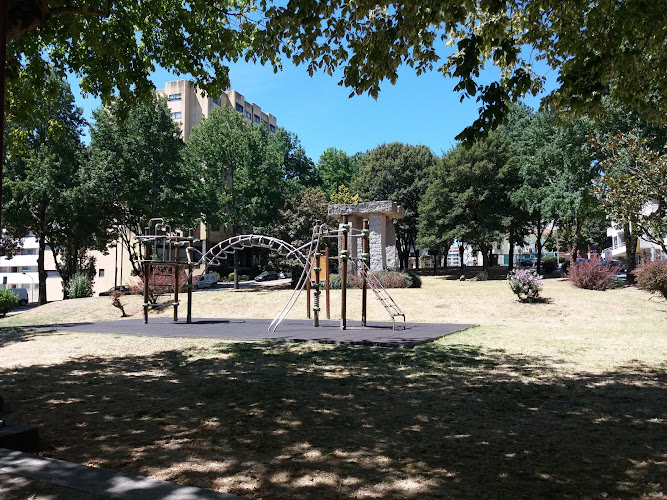
Miradouro da Vitória is a free, informal viewpoint in Porto’s historic Vitória district, set above the dense roofscape that tumbles toward the Douro. It is not a manicured park or a monument with an interpretive route; the reward is an unusually open urban panorama framed by old lanes, stone façades and the layered hillsides of the river valley.
From its rough-surfaced terrace near São Bento da Vitória, the view gathers several of Porto’s defining landmarks in one sweep: the cathedral and Episcopal Palace above the lower town, Ribeira’s packed roofs, the iron arc of Dom Luís I Bridge, and Vila Nova de Gaia across the water. It is a brief stop with a big visual payoff, especially for travelers walking between the city’s upper historic streets and the riverside.
Standout Highlights & What Not to Miss
The viewpoint’s strength is context rather than a single posed photo. Take a few minutes to let the scene resolve: steep streets lead down through the historic center, civic and religious landmarks rise above residential roofs, and the river explains why Porto developed along this dramatic slope. The terrace is especially useful for understanding the relationship between the upper town, Ribeira and Gaia before exploring them at street level.
- The Douro panorama: Follow the river as it curves past the lower city, with the opposite bank of Gaia spreading across the horizon.
- Dom Luís I Bridge: The bridge’s recognizable metal arch makes a strong focal point and helps orient the riverfront below.
- Cathedral-side skyline: Look toward the higher ridge for Porto Cathedral and the adjoining historic core, then compare its monumental stone buildings with the tightly clustered rooftops beneath.
- Gaia’s wine-lodge landscape: Across the Douro, the broad riverside strip and slopes of Vila Nova de Gaia show the other half of Porto’s celebrated river setting.
- A quieter historic-center pause: The location sits amid Vitória’s older lanes, an area associated with Porto’s former Jewish quarter, the Judiaria do Olival. Use the stop as a reason to slow down rather than rush straight downhill.
Visitor Strategy & Planning Snapshot
| Planning Factor | What to Expect | Practical Strategy |
|---|---|---|
| Ideal Arrival Window | The open view is most pleasant in softer light, while the exposed terrace can feel more intense in strong sun. | Visit early or later in the day for gentler light and allow time to wait for a clear view if other visitors are photographing. |
| Typical Time Needed | Most visitors spend 20 to 40 minutes taking in the view, making images and getting their bearings. | Build in a short pause, then continue on foot toward the cathedral area, Clérigos or Ribeira. |
| Booking / Queue Reality | This is a free, informal lookout rather than a ticketed attraction with a timed-entry system. | No advance booking is needed; arrive with flexible expectations, since the best photo positions can be temporarily occupied. |
| Terrain & Accessibility | Approach streets slope, and the terrace surface is rough and uneven. There is no dedicated visitor lift. | Wear secure shoes, watch footing near uneven ground, and choose a different viewpoint if step-free access is essential. |
| Weather / Seasonal Fit | Cloud, haze, rain and low sun can dramatically change visibility across the valley. | Check conditions on the day and keep this as a flexible stop; a clear spell can be enough for a memorable panorama. |
Honest Trade-Offs: Best For vs. Who Might Skip
This is one of Porto’s best choices for cityscape photographers, budget-minded visitors, river-view seekers and walkers who enjoy piecing together a historic neighborhood. Free admission and the breadth of the view are substantial advantages. The trade-off is its unpolished character: do not expect landscaped gardens, a café, formal interpretation, sheltered seating or a polished observation deck. The irregular surface and sloping access can be uncomfortable for travelers with limited mobility, strollers or a strong preference for barrier-free attractions. Visitors seeking a destination with a substantial indoor visit, services or a structured museum-style experience may find it too brief. Those comfortable with a simple lookout, however, can get a remarkably complete visual introduction to central Porto in less than an hour.
Neighborhood Context & How to Pair Your Visit
Miradouro da Vitória works best as part of a walk rather than a standalone journey. Begin in the upper historic center around São Bento da Vitória and the nearby monastery streets, then use the terrace to see where you are headed. From there, continue toward Porto Cathedral and its elevated surroundings, or descend through the old center toward Ribeira for a street-level contrast with the rooftops and river you have just seen. In the other direction, the lanes lead toward the Clérigos area and central Porto’s shops, churches and cafés. Keep the route flexible: downhill segments are rewarding but steep, and the viewpoint’s rough ground makes it sensible to save a little energy for the walk back uphill or onward to your next stop.
For photographers, treat the terrace as a wide establishing shot before seeking details elsewhere: bridge structure from the riverbanks, façades in Ribeira, and the cathedral skyline from the surrounding slopes. For everyone else, the value is simpler: pause, identify the landmarks, and let the panorama turn a dense maze of streets into a legible city.
When planning your Porto travel guide or browsing verified attractions in Porto, pair this stop with standout local spots including Muu Steakhouse, Porto Palácio Hotel by The Editory, Vila Foz Hotel & Spa, and Bota&Bira (nearby).