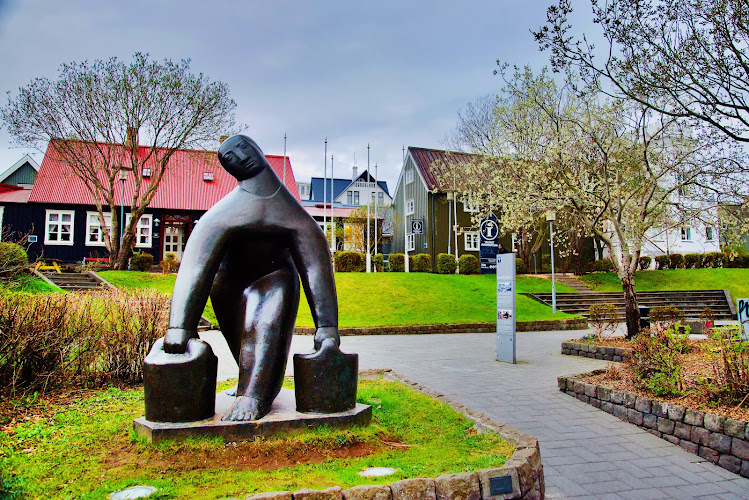
Tjörnin, “the Pond,” is a shallow urban lake that fills the middle of downtown Reykjavík. It covers roughly 8.7 hectares and is only about 80 centimeters deep at its deepest point. A walking path of around 1.4 kilometers circles it, so locals use it for jogging, pram-pushing and the commute between the Miðborg offices and the quieter streets to the south. Its reputation rests on birdlife: swans, ducks, geese and gulls gather here in the thousands across the year, and the survey of regular species runs to about forty.
The setting does a lot of the work. Reykjavík City Hall stands partly over the northern edge of the water, the National Gallery and Fríkirkjan church sit along the eastern shore, and brightly painted corrugated-iron houses line the western side. To the south, the grass and trees of Hljómskálagarður park open out. Admission is free, nothing needs booking, and the pond never closes. It is a place for a slow loop rather than a checklist, and it changes more with the season than almost anywhere else in the city.
Standout Highlights & What Not to Miss
The pond is small enough to see in one lap, but the best moments depend on where you stop and which season you come in. These are the spots worth slowing down for.
- The City Hall edge: the building reaches out over the water, and its public ground floor (with a large relief map of Iceland) makes a warm break if the wind is up. Ducks paddle right beneath the windows.
- Swans and ducks at close range: the northern and eastern banks are where birds crowd the shoreline. Whooper swans, mallards, tufted ducks, greylag geese and Arctic terns in summer all show up within a few meters of the path.
- The frozen pond in winter: in hard cold the surface becomes an informal skating rink, a tradition tied to the Reykjavík skating association founded here in 1892. Only step on when the ice is officially confirmed safe, and watch for signs.
- The bridge and the western houses: the narrow Skothúsvegur bridge splits the pond. It gives the classic photo of colored rooftops, church spire and water in one frame, best in low light.
- Hljómskálagarður on the south shore: lawns, benches, sculptures and the small Hljómskálinn music pavilion. This is where locals spread out a picnic on a rare warm afternoon.
- The Bread Soup tradition: Icelanders jokingly call the pond “the biggest bread soup in the world” after generations of bread feeding. The city now asks visitors to skip bread, especially May to August, and bring seeds or grains instead.
Visitor Strategy & Planning Snapshot
| Planning Factor | What to Expect | Practical Strategy |
|---|---|---|
| Ideal Arrival Window | Early morning or the hour before sunset gives soft light, fewer tour groups and active birds. | Walk it counterclockwise from City Hall so the church and houses sit ahead of you in the light. In midsummer, late evening light lasts for hours. |
| Typical Time Needed | A full loop takes 20 to 30 minutes at a stroll; most people stay 45 to 90 minutes with photo and bench stops. | Add time if you plan to picnic in Hljómskálagarður or pair it with City Hall or the National Gallery. |
| Booking / Queue Reality | Free and open access with no tickets, no queues and no timed entry. | Nothing to reserve. Bring seeds or oats rather than bread if you want to feed the birds, and keep a respectful distance from nesting birds. |
| Terrain & Accessibility | Mostly flat, paved or compacted paths around the water, with a few gravel sections and bridges. Generally easy for strollers and many wheelchair users. | Ice and snow can make winter paths slick, so wear traction footwear. Check the surface before using any bench-side shortcuts onto grass. |
| Weather / Seasonal Fit | Works year-round: nesting and long light in summer, bare scenery and possible ice in winter, wind in any season. | Pack a windproof layer even in June. In winter, heed local ice warnings and never assume the surface is safe without confirmation. |
Honest Trade-Offs: Best For vs. Who Might Skip
Tjörnin suits travelers who enjoy unhurried, low-cost stops: birdwatchers, photographers, families with children who like animals, and anyone who wants a breather between museums. It is also an easy fit for a layover day or a rainy-weather gap, since you can do a quick lap and duck into City Hall. Winter visitors get a particularly local scene when the surface freezes and the birds gather in open patches of water.
It is not a dramatic landscape. If you came to Iceland for waterfalls, glaciers and volcanic scenery, this is a modest urban pond and will feel quiet by comparison. Summer can bring noisy gulls and the occasional protective nesting bird near the path, and the cold wind off the water is more biting than the temperature suggests. Birdwatchers wanting rare species will do better at coastal sites outside the center, while Tjörnin rewards casual, close-up viewing.
Neighborhood Context & How to Pair Your Visit
Tjörnin sits in the heart of Miðborg, so a half-day route is simple. Start at Austurvöllur square and the Parliament building, then step into City Hall to see the relief map and look out over the water. Walk the pond clockwise or counterclockwise, pausing at the bridge for photos and at Hljómskálagarður for a sit-down. On the east shore you pass the National Gallery and Fríkirkjan, both worth a look if you want an indoor stop.
From there the shopping and café streets around Laugavegur and Skólavörðustígur are a short uphill walk, with Hallgrímskirkja as a natural finish. Bakeries and coffee shops on the streets west of the pond are good for a warm-up in winter. Everything is walkable, so no transport is needed, and the whole sequence fits comfortably into four to five hours with lunch included.
When planning your Reykjavik travel guide or browsing verified parks in Reykjavik, pair this stop with standout local spots including Austurvöllur, Reykjavík Headshop, Hafnarsaga, and Mæðragarðurinn (nearby).