
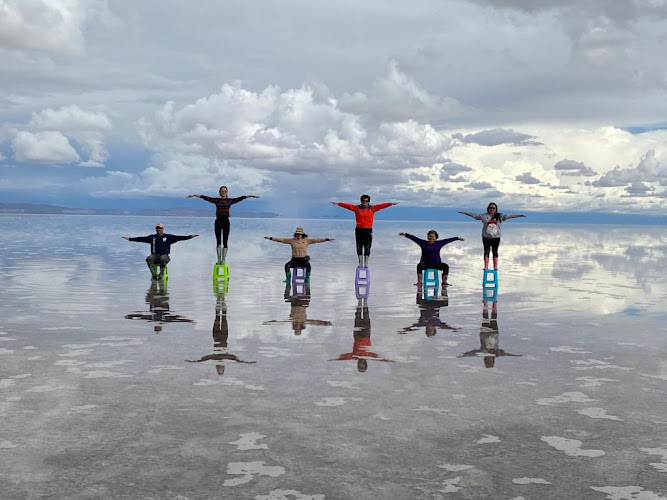
Uyuni State Park is an open, high-altitude salt-flat landscape at QFQR+4VQ, Colcha "K, Bolivia, on the Salar de Uyuni in southwestern Potosí Department. It is visited for the immense white crust, horizon-level photographs and access to the Altiplano’s lagoons, volcanoes and rock formations; this is a remote natural area rather than a developed urban park, shaped by the evaporation of prehistoric Lake Minchin.
What to Expect at Uyuni State Park
The defining experience is the Salar itself: a hard, hexagonal salt crust that extends toward distant mountain ranges and feels almost featureless until a 4×4 track, salt pile or cactus-covered island breaks the view. In the dry season, the crystalline surface creates sharp shadows, forced-perspective photographs and a broad white horizon. During the summer rains, a thin film of water can turn the surface into a giant mirror, though routes and access depend on weather and the judgment of local drivers.
Come prepared for a serious Andean environment. The salt flat sits at roughly 3,650 metres above sea level, where glare, wind, cold mornings and rapid weather changes are routine. There are no formal galleries, visitor centre, café, shop, toilets or marked walking trails at this pin. Most visitors arrive on a guided 4×4 circuit from Uyuni, Colchani or Colcha K, combining salt-flat stops with the train cemetery, Isla Incahuasi, coloured lagoons, geysers and desert scenery on longer itineraries.
- Salt polygon crust: Dry-season hexagonal salt patterns make the ground itself the principal subject for photography.
- Mirror season: Summer rain can leave a shallow reflective layer that merges sky and land, especially around sunrise and late afternoon.
- Isla Incahuasi: A rocky outcrop of giant columnar cacti and coral fossils rises from the salt flat about 13 kilometres southwest by 4×4 route.
- Altiplano wildlife circuit: Multi-day excursions commonly continue to high lagoons where Chilean, Andean and James’s flamingos feed.
- Night-sky setting: With no city lighting on the salar, clear, moonless nights offer unusually dark conditions; go only with an experienced operator.
Uyuni State Park at a Glance
| Detail | Information |
|---|---|
| Address | QFQR+4VQ, Colcha "K, Potosí Department, Bolivia |
| Neighborhood / Area | Salar de Uyuni, Colcha K municipality, southwestern Bolivian Altiplano |
| Operating Hours | Open 24 hours daily; safe practical access is by daylight with a licensed 4×4 driver |
| Admission / Price Range | Free open landscape; guided 4×4 transport is the practical paid expense |
| Recommended Visit Duration | 2 to 4 hours on the salar; 1 to 3 days for a wider Uyuni circuit |
| Nearest Transit / Parking | No scheduled stop at the site; arrange a 4×4 from Uyuni, Colchani or Colcha K. Park only where your driver designates on firm salt. |
| Official Website & Phone | No dedicated on-site visitor office or published contact point |
Visiting Tips, Getting There & Nearby Pairings
Start early for calmer light and fewer vehicle tracks in photographs, or stay through late afternoon for long shadows and sunset colour. Book a reputable 4×4 operator before arriving in the region, particularly in the wet season, and confirm whether the route includes Isla Incahuasi and whether water conditions permit mirror photography. Carry several litres of water, sunscreen, lip balm, dark glasses, a warm outer layer and shoes you do not mind getting salty. Altitude sickness can affect even fit travellers, so acclimatize in Uyuni or Colcha K and avoid rushing on arrival.
There is no public bus, rail station or conventional parking facility on the salt flat. Uyuni is the principal transport hub, with flights and bus connections, while Colcha K is a useful southern-salar staging village; all onward travel requires an organized vehicle or private 4×4. The terrain is broadly level but not wheelchair-ready: loose or ridged salt, vehicle transfers, wind and the absence of accessible toilets make independent navigation difficult. Isla Incahuasi has uneven paths and a steep climb. Nearby pairings are reached by vehicle, not on foot: Isla Incahuasi, the village of Colcha K and the southern Altiplano lagoon route are the logical additions.
Frequently Asked Questions
What are the hours and best time to visit Uyuni State Park?
The landscape is accessible around the clock, but daylight travel is strongly preferable because navigation across the salar is specialized. Arrive soon after sunrise for clean light and lower glare, or plan sunset with a guide; the wet-season mirror effect is most likely during the austral summer.
Is there an entrance ticket or reservation requirement?
There is no separate admission ticket for this open salt-flat location. A guided 4×4 excursion is the normal way to visit, and advance reservations are wise in peak travel periods and whenever you want a multi-day lagoon itinerary.
How much time should I allow?
Allow two to four hours for photographs and a salt-flat drive from a nearby base. Give the region one full day to add Isla Incahuasi, or two to three days for the lagoons, desert formations and high-altitude wildlife route.
Is Uyuni State Park suitable for families and wheelchair users?
Families can enjoy the enormous open space and playful perspective photographs when accompanied by a reliable driver and protected from sun and wind. The flat surface can look easy, but it has no accessible facilities or maintained paths; travellers using wheelchairs should arrange a vehicle that can accommodate their needs and discuss transfers in advance.
When planning your Salar de Uyuni travel guide or browsing verified attractions in Salar de Uyuni, pair this stop with standout local spots including Uyuni Salt Flat, Las Tholas Hotel, " La chapaquita" Churrasqueria – Restaurante, and Uyuni Salt Lake (8.3 km away).


