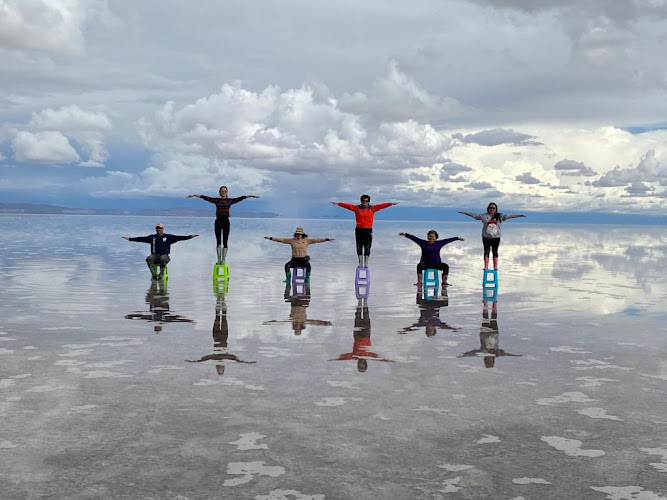
Uyuni Salt Flat is the vast high-altitude salt pan of Salar de Uyuni in the Uyuni Municipality of Daniel Campos Province, Potosí Department, Bolivia, accessed from the town of Uyuni and its 4×4 tour departure points. At 3,656 metres above sea level and covering roughly 10,582 square kilometres, it is the world’s largest salt flat: travelers come for its geometric salt crust, wet-season mirror effect, giant-perspective photographs, cactus-covered islands and the otherworldly silence of the Altiplano.
What to Expect at Uyuni Salt Flat
The salar is the evaporated remnant of ancient prehistoric lakes, including Lake Minchin. In the dry months, a hard white surface breaks into natural hexagonal polygons stretching to a horizon that erases scale. Tours usually leave Uyuni in the morning by high-clearance 4×4, pause at salt mounds and the small salt-processing settlement of Colchani, then drive onto the open plain for photography and lunch. The air is intensely bright; sunglasses, sunscreen, windproof layers and several litres of water are practical essentials.
Most full-day routes include Isla Incahuasi, a rocky outcrop of fossilized coral rising from the salt. Its signed footpath climbs through giant cardón cacti, including specimens hundreds of years old, and opens onto panoramic views across the salar. From roughly January through April, rainwater can form a thin reflective sheet that turns the surface into a sky mirror; routes may change or be restricted after heavy rain. In the dry season, drivers can reach farther across the crust and create the classic forced-perspective images. Seasonal shallow-water areas support Andean flamingos, while longer 4×4 circuits reach the more reliable flamingo lagoons of the southern Altiplano.
- Hexagonal salt crust: The dry-season surface reveals crisp, repeating salt polygons ideal for wide-angle landscape photographs.
- Mirror season: Summer rainfall creates a thin reflective layer, producing horizon-to-horizon sky reflections when conditions allow.
- Isla Incahuasi: A coral-rock island with giant cacti, a walking trail and elevated views over the white plain.
- Colchani salt works: Near the northern edge, local producers rake, dry and bag salt using traditional small-scale methods.
- Sunrise and sunset light: Low light gives the flats blue, pink and gold tones, but requires a licensed driver and warm clothing.
Uyuni Salt Flat at a Glance
| Detail | Information |
|---|---|
| Address | Salar de Uyuni, Uyuni Municipality, Daniel Campos Province, Potosí Department, Bolivia |
| Neighborhood / Area | Southern Altiplano; principal access is from Uyuni, about 22 km south of Colchani |
| Operating Hours | No formal gate hours; guided excursions generally operate in daylight, with sunrise and sunset departures by arrangement |
| Admission / Price Range | No single salar admission ticket; guided 4×4 excursions are paid separately and typically fall in the $$ range |
| Recommended Visit Duration | One full day from Uyuni; allow three to four days for routes continuing into the Eduardo Avaroa reserve |
| Nearest Transit / Parking | Uyuni Airport and Uyuni rail/bus terminal; tours use 4×4 vehicles, with no independent public parking on the salt |
| Official Website & Phone | No single on-site official visitor website or telephone; book through a licensed Uyuni-based operator |
Visiting Tips, Getting There & Nearby Pairings
Book a reputable operator in Uyuni at least a day ahead in peak dry-season months and confirm whether Isla Incahuasi, meals, oxygen, English-speaking guidance and rain-season route changes are included. Departing early brings firmer light and more time before afternoon cloud or wind. Avoid attempting to self-drive: navigation is difficult, rainwater can conceal soft areas, and experienced drivers carry communications, recovery gear and knowledge of safe routes. Uyuni Airport has flights from La Paz, while the town’s terminal connects by bus and train with other Bolivian cities.
This is not a conventional accessible attraction. Getting onto the salar involves climbing in and out of a 4×4 over uneven salt, and there are no paved step-free paths, regular toilets, shade structures or reliable rest areas on the open plain. Travelers who use wheelchairs or have limited mobility should ask an operator about vehicle transfer assistance and an itinerary that remains near accessible roadside stops. The Train Cemetery, about 7 km southwest of Uyuni, is a popular pre- or post-tour stop; in town, Plaza Arce, the clock tower and the central market are an easy walk from many hotels and tour offices. Colchani’s salt stalls are usually visited by vehicle rather than on foot from Uyuni.
Frequently Asked Questions
When is Uyuni Salt Flat open, and what is the best time to go?
The salar has no gate and is accessible year-round through guided excursions. Visit from May to October for the dry, polygon-patterned crust, or from January to April for potential mirror reflections; morning departures provide the longest daylight window.
Do I need to buy a ticket or reserve a tour?
There is no universal entry ticket for the open salt flat, but travelers normally visit with a paid 4×4 operator from Uyuni. Reserve ahead during holidays and dry-season high demand, and verify any separate Isla Incahuasi or protected-area charges before departure.
How much time should I budget for Salar de Uyuni?
A full-day excursion covers the salt crust, Colchani and usually Isla Incahuasi, with time for perspective photography. Choose a three-day or four-day circuit if you also want high-altitude lagoons, geysers and desert scenery south of the salar.
Is the Uyuni Salt Flat suitable for children or travelers with mobility needs?
Families can enjoy the playful scale and short photo stops, provided children are protected from intense sun, cold wind and altitude. Mobility access is limited by 4×4 transfers and rough terrain; Isla Incahuasi’s cactus trail includes uneven steps and is not wheelchair accessible.
When planning your Salar de Uyuni travel guide or browsing verified hotels in Salar de Uyuni, pair this stop with standout local spots including Hotel Luna Salada, LLAMA CAFE, HOTEL CASA DE SAL, and Uyuni State Park (8.9 km away).