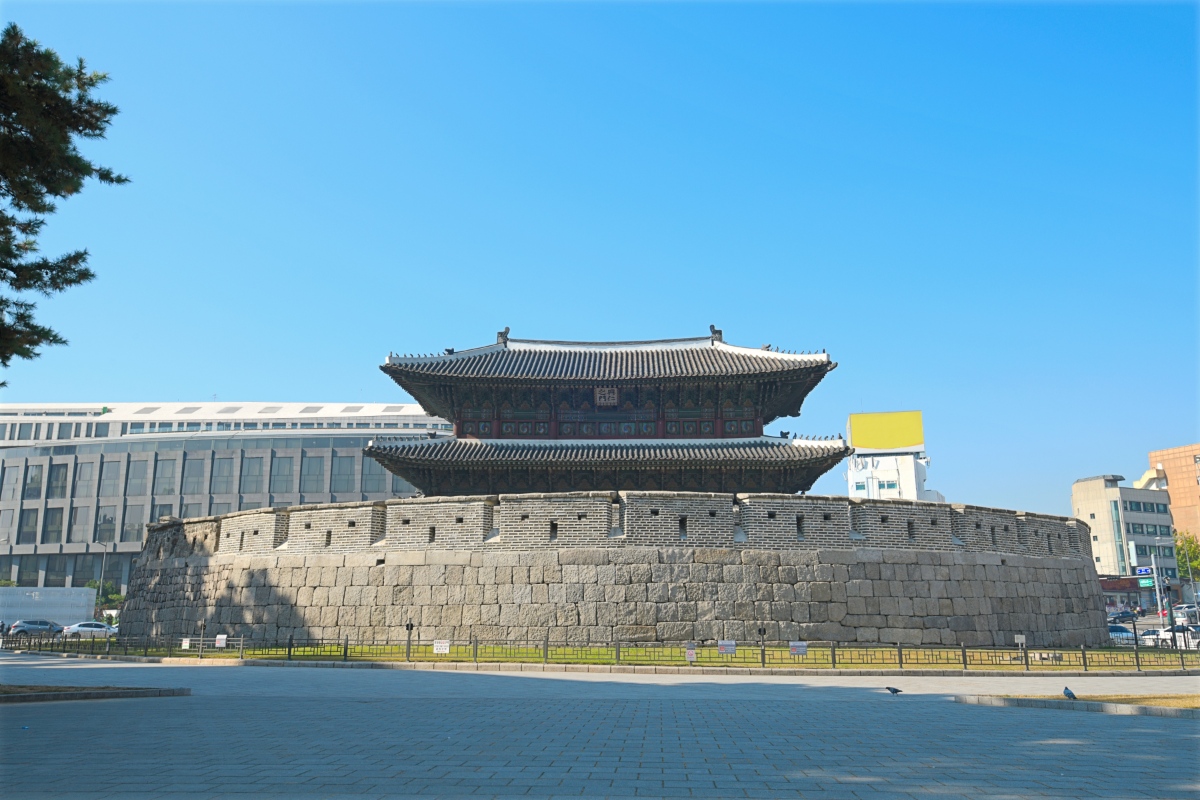
Heunginjimun Gate, widely called Dongdaemun or the Great East Gate, is Seoul’s surviving eastern gateway from the Joseon-era capital wall. Its massive granite arch carries a two-story timber pavilion above the traffic of Jongno 6-ga, making the contrast between old Hanyang and contemporary Seoul unusually immediate. Look closely and the formal roofline, painted dancheong brackets, and deep eaves reveal why this was one of the capital’s four principal gates rather than simply a passage through a wall.
The gate’s setting is as much part of the experience as the structure itself. Wholesale-market streets and major city roads press close by, while the green rise of the adjacent city-wall park begins just north of the monument. First built in 1396 under King Taejo, the gate seen today is principally the 1869 reconstruction completed during King Gojong’s reign. It is best approached as an outdoor architectural and urban-history stop, not as a museum with a long interior circuit.
Standout Highlights & What Not to Miss
Give yourself time to circle the site rather than taking one front-facing photograph and moving on. Heunginjimun’s most unusual feature is not the pavilion alone: its defensive design explains the gate’s distinctive shape and rewards a slow look from several angles.
- The crescent-shaped ongseong: This curved outer defensive wall wraps the approach to the gate. It is the feature that sets Heunginjimun apart from Seoul’s other surviving great gates; walk the perimeter to see how it complicated a direct approach.
- Granite arch and passage: Stand back far enough to read the scale of the stone base, then look through the vaulted opening. The arch gives the timber pavilion a remarkably weighty, fortress-like foundation.
- Two-story pavilion: The timber upper structure, hipped-and-gabled roof, and layered eaves signal the gate’s ceremonial importance. The pavilion is for viewing from outside; ordinary visitors should not expect an ascent or lookout deck.
- Dancheong details: The traditional painted decoration is easiest to appreciate by looking upward beneath the eaves. A closer view also brings out the rhythm of brackets, beams, and supporting columns.
- Evening illumination and the park slope: After dusk, lighting gives the pavilion a stronger silhouette against surrounding buildings. By day, continue toward Heunginjimun Park for the visual link between the gate and the wall climbing toward Naksan.
Visitor Strategy & Planning Snapshot
| Planning Factor | What to Expect | Practical Strategy |
|---|---|---|
| Ideal Arrival Window | Street activity, changing light, and traffic shape the views more than a formal entry schedule. | Come in daylight for architectural detail, or return around evening for a more dramatic city-lit composition. |
| Typical Time Needed | The gate itself is a compact exterior stop, but the defensive wall and nearby park invite a longer pause. | Allow 30 to 45 minutes for a circuit, photographs, and a short uphill look toward the wall. |
| Booking / Queue Reality | This is principally a public exterior landmark rather than an interior tour experience. | No elaborate visit plan is needed; leave flexibility for crossings, crowds, and finding your preferred angle. |
| Terrain & Accessibility | Paved sidewalks provide exterior viewpoints. The adjacent park rises uphill with stepped sections, and the pavilion has no visitor elevator. | Stay on the level perimeter for the easiest visit; treat the park and wall segment as optional for anyone avoiding slopes or stairs. |
| Weather / Seasonal Fit | The site is exposed, with limited shelter on surrounding streets and in the open viewing areas. | Clear conditions suit wide photos; bring rain protection in wet weather and layers for windier, colder walks along the park. |
Honest Trade-Offs: Best For vs. Who Might Skip
Heunginjimun is especially rewarding for Joseon-history enthusiasts, traditional-architecture lovers, city-wall walkers, and photographers who enjoy the tension between heritage and dense modern streets. It delivers a memorable structure in a short visit and has a genuinely rare defensive element. The trade-off is that it is not a quiet palace compound: road noise, crossings, and market bustle are integral to the setting, and access is mainly visual and exterior. Travelers seeking galleries, extensive interpretation, indoor exhibits, or a climb to a panoramic platform may find the stop brief unless they pair it with the park or surrounding districts.
Neighborhood Context & How to Pair Your Visit
Build Heunginjimun into a walk through eastern central Seoul rather than treating it as an isolated photo stop. Start at the gate and trace the park-side rise toward the remaining city-wall landscape, then descend into the Dongdaemun market area for the neighborhood’s commercial energy. The Dongdaemun Design Plaza area also makes a useful modern counterpoint to the gate’s timber-and-stone form. If you prefer a flatter route, keep to Jong-ro’s paved sidewalks, take in the ongseong from more than one side, and continue toward food, shopping, or a later evening stroll. This pairing makes clear how an old capital threshold still anchors one of Seoul’s busiest urban quarters.
When planning your Seoul travel guide or browsing verified attractions in Seoul, pair this stop with standout local spots including The Westin Josun Seoul, Seoul Children's Museum, Andaz Seoul Gangnam – A Concept by Hyatt, and Name-engraved Stones in Hanyangdoseong Fortress (nearby).