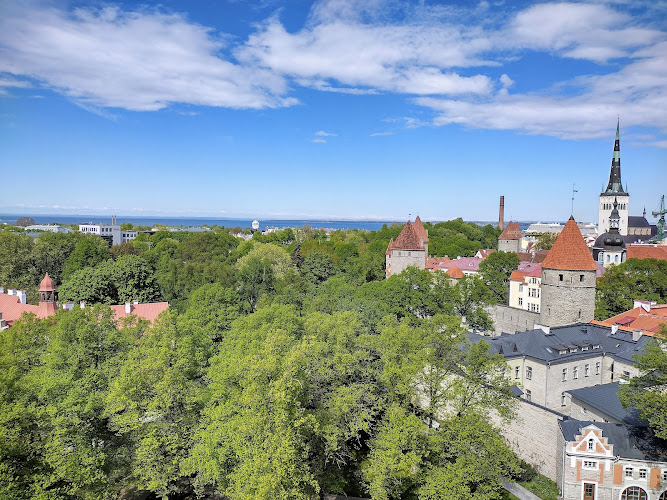
Viru Gate is Tallinn’s instantly recognizable threshold between the modern city centre and the medieval Old Town. Two round 14th-century limestone towers, topped with steep red-tile roofs and often softened by ivy, stand at the eastern end of Viru Street. They are the surviving outer section of a once more elaborate fortified entrance, and today they provide one of the clearest visual introductions to the UNESCO-listed historic core.
The gate sits where the activity of Viru Square gives way to pedestrian streets, flower kiosks and old wall lanes. Walk through the towers and Viru Street rises gently into a busy corridor of merchant-house façades, cafés and small shops; turn toward Müürivahe and the town wall becomes the backdrop for knitwear stalls. This is not a museum interior or a long attraction, but a compact, atmospheric landmark that rewards looking closely before moving deeper into Old Town.
Standout Highlights & What Not to Miss
Viru Gate works best as both a photo stop and an orientation point. Pause outside the towers first, then pass through them slowly rather than treating them as scenery to rush past. The contrast between the stone fortifications, seasonal foliage, market activity and the street beyond explains why this is among Tallinn’s most photographed gateways.
- The twin towers: Frame both cylindrical towers together to show their narrow passage, pointed roofs and defensive medieval character. Their proportions make the gate feel more intimate than a grand city portal.
- Ivy and changing colour: In the warmer months, greenery can cloak much of the stone; later in the year, the foliage may shift in colour. The towers remain compelling in bare-season light, when the masonry is easier to read.
- Flower-stall atmosphere: The kiosks near the approach add colour and everyday life to what could otherwise be a purely architectural stop. Keep the vendors in view without blocking their working space.
- The Sweater Wall lane: Follow Müürivahe beside the old wall for stalls selling woollens such as sweaters, scarves and mittens. It is a useful detour for visitors seeking locally themed souvenirs rather than generic Old Town browsing.
- Viru Street beyond the gate: Continue uphill through the passage for a strong first impression of Old Town, then branch off onto smaller lanes before the main pedestrian flow becomes too dense.
Visitor Strategy & Planning Snapshot
| Planning Factor | What to Expect | Practical Strategy |
|---|---|---|
| Ideal Arrival Window | The gateway is a major meeting point and a natural route into Old Town, so the central passage can feel busy. | Come early for calmer photographs, or return after dusk to see the towers illuminated and the street take on a different character. |
| Typical Time Needed | A focused stop takes about 15 to 30 minutes, longer if you browse the nearby stalls or use the gate as a starting point for a walk. | Allow extra time if photography matters; walk a short distance in each direction for more varied compositions. |
| Booking / Queue Reality | This is an outdoor public landmark rather than a ticketed interior, with no conventional entry queue. | Simply build it into your route. Crowding is the main consideration, especially when tour groups arrive. |
| Terrain & Accessibility | The approach from Viru Square is paved and flat, while the surface inside and beyond the gate includes uneven cobblestones. | Wheelchair users and visitors with strollers can reach the approach easily but should proceed carefully over the cobbles and consider a smoother route nearby. |
| Weather / Seasonal Fit | The gate is exposed to wind, rain and winter slickness, while summer foliage gives it its classic ivy-covered appearance. | Wear shoes with grip in wet or icy conditions; overcast weather can be excellent for capturing the stone without harsh contrast. |
Honest Trade-Offs: Best For vs. Who Might Skip
Viru Gate is best for first-time visitors, architecture fans, history-minded travelers and photographers who want an unmistakably Tallinn image without committing much time. It is especially satisfying for people who enjoy noticing how a surviving fragment of fortification still organizes the city’s daily movement. The trade-off is that there is little interpretive material on site and no enclosed attraction to explore: visitors seeking a detailed history lesson, a quiet hidden corner, or a substantial stand-alone activity may find it too brief. Think of it as a memorable doorway and scene-setter, not a destination requiring an entire afternoon.
Neighborhood Context & How to Pair Your Visit
Make Viru Gate the opening marker for a walk from the city centre into Old Town. Start on the Viru Square side for the classic outward-looking view, pass between the towers, then follow Viru Street toward Town Hall Square. Before or after, slip into Müürivahe to browse the knitwear stalls against the wall, and continue along side streets where the crowds thin out. The gate also pairs naturally with an evening stroll: take daytime photos when stalls and street life are active, then revisit after dark for floodlit stone, a quieter visual mood and a clear sense of Old Town’s boundary between past and present.
When planning your Tallinn travel guide or browsing verified attractions in Tallinn, pair this stop with standout local spots including Tallinn Town Hall, Patkuli Viewing Platform, NOA Restaurant, and Pelmen kohvik (nearby).