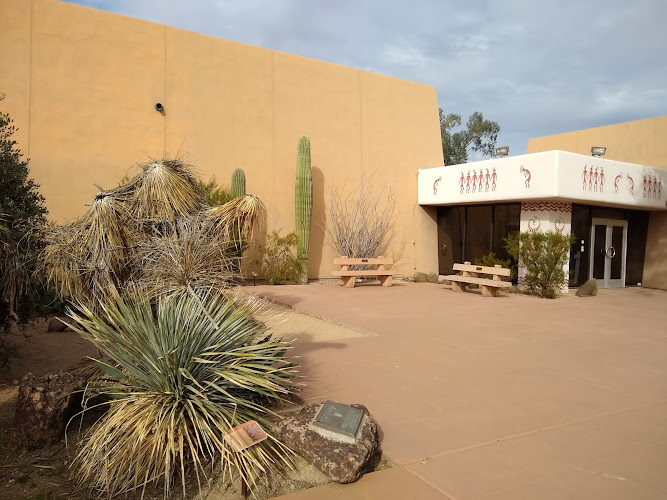
Huhugam Ki Museum is the cultural museum of the Salt River Pima-Maricopa Indian Community at 10005 E Osborn Rd, Scottsdale, AZ 85256, on the Salt River Pima-Maricopa Indian Community east of central Scottsdale. Its name means “House of the Ancestors,” and its exhibits introduce the Hohokam heritage of the Salt River Valley alongside the continuing cultures of the Onk Akimel O’odham and Xalychidom Piipaash peoples. Travelers come for a focused, community-centered account of archaeology, ancestral technology, and living Native traditions.
What to Expect at Huhugam Ki Museum
The museum gives valuable context to the desert landscape beyond its doors. Archaeological displays examine the Hohokam, whose canal networks redirected Salt River water for farming long before modern Phoenix and Scottsdale developed. Look closely at pottery, stone tools, shell ornaments, and material connected with domestic work, trade, and food production; these objects make the scale and sophistication of the Hohokam world tangible. Interpretive panels connect the ancient past to a homeland that remains central to the Salt River Pima-Maricopa Indian Community.
The second essential thread is cultural continuity. The Salt River Pima-Maricopa Indian Community is home to the Onk Akimel O’odham, or River People, and the Xalychidom Piipaash, or Maricopa people. Exhibits address traditions, lifeways, and the community’s relationship with the Salt River Valley rather than treating Indigenous history as a closed chapter. Allow time to read labels rather than rushing through: this is a compact museum with an interpretive depth that rewards an unhurried visit. School and organized groups should contact the museum in advance about guided visits, and visitors should ask staff before photographing displays or cultural materials.
- Hohokam archaeology: Artifacts and interpretation trace the region’s pre-contact farming communities and their long occupation of the Salt River Valley.
- Canal engineering: Learn how extensive hand-built irrigation channels made intensive desert agriculture possible.
- Pottery and tools: Ceramic vessels, stone implements, and other excavated materials illuminate daily labor, cooking, and craft.
- O’odham and Piipaash heritage: Community interpretation places the Onk Akimel O’odham and Xalychidom Piipaash at the center of the story.
- Local perspective: The museum sits within the 52,600-acre Salt River Pima-Maricopa Indian Community, established by executive order on June 14, 1879.
Huhugam Ki Museum at a Glance
| Detail | Information |
|---|---|
| Address | 10005 E Osborn Rd, Scottsdale, AZ 85256 |
| Neighborhood / Area | Salt River Pima-Maricopa Indian Community, east Scottsdale/Salt River Valley |
| Operating Hours | Monday-Friday, 9:30am-4:30pm; closed Saturday and Sunday |
| Admission / Price Range | Free admission; $ |
| Recommended Visit Duration | 45 to 75 minutes |
| Nearest Transit / Parking | Car access is most practical; use the Loop 101 via McKellips Road and confirm visitor parking with the museum. Valley Metro service is limited in this reservation area. |
| Official Website & Phone | Salt River Pima-Maricopa Indian Community; 480-362-6320 |
Visiting Tips, Getting There & Nearby Pairings
Arrive near the 9:30am opening for the quietest gallery time and the fullest chance to speak with staff. Weekday hours make the museum especially useful for a morning cultural stop before lunch or an afternoon event elsewhere in the Talking Stick area. Admission is free, but call ahead for group visits, holiday-week hours, research inquiries, and current photography guidance. The museum is a respectful cultural space: keep voices low, do not touch artifacts, and follow any staff direction about sensitive material.
This is a vehicle-oriented part of the metro area, reached most easily from Loop 101 and McKellips Road; confirm on-site visitor-parking arrangements when calling. The museum’s public visitor areas are on a straightforward, single-level layout, making it a manageable stop for wheelchairs and strollers; contact staff before arrival for specific mobility assistance or accessible-parking needs. Nearby destinations are spread beyond an easy walk, so pair the visit by car with Salt River Fields at Talking Stick, Talking Stick Resort, or the Scottsdale waterfront and Old Town Scottsdale, each offering a contrasting view of the contemporary valley.
Frequently Asked Questions
What are Huhugam Ki Museum’s hours, and when is the best time to go?
The museum is open Monday through Friday from 9:30am to 4:30pm and is closed on weekends. Go at opening for a quieter visit and more time with the interpretive displays before midday commitments; call before visiting around public holidays.
Does Huhugam Ki Museum charge admission or require reservations?
Admission is free. Individual visitors can generally visit during weekday opening hours, while school groups and larger parties should phone 480-362-6320 in advance to arrange an appropriate visit.
How long should I budget for the museum?
Plan 45 to 75 minutes for the exhibits, with extra time if you want to study the canal and archaeology interpretation closely. It works well as one part of a half-day itinerary around the Salt River Valley and Talking Stick area.
Is Huhugam Ki Museum suitable for families and visitors with mobility needs?
Yes. The concise, artifact-led galleries give families a clear introduction to Hohokam technology and O’odham and Piipaash culture, and the single-level public layout is practical for strollers and wheelchairs. Contact the museum before arrival to coordinate any particular accessibility requirement.
When planning your Tempe travel guide or comparing verified attractions and museums in Tempe, pair this stop with standout local spots including ASU Art Museum Ceramics Research Center, RigaTony's Authentic Italian Restaurant, Hall of Flame Fire Museum, and Thirsty Lion (7.1 km away).