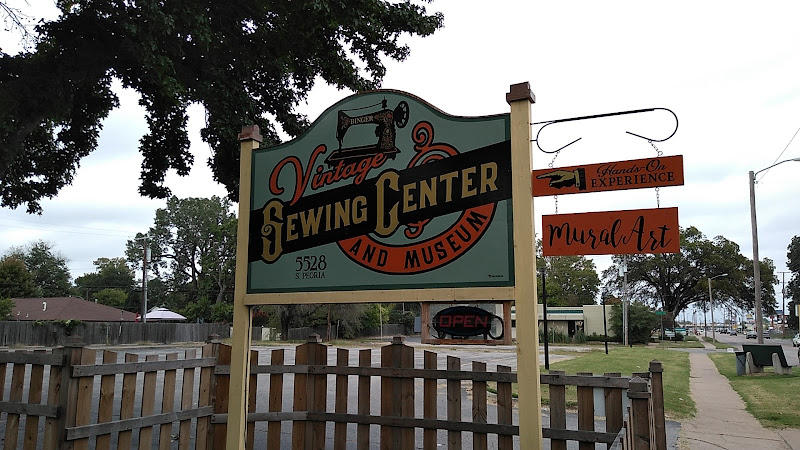
Vintage Sewing Machine Museum, also known as the Vintage Sewing Center and Museum, is a specialist collection at 5528 S Peoria Avenue, Tulsa, Oklahoma 74105, in the South Peoria corridor south of Brookside. Its antique sewing machines trace the mechanization of a once entirely manual household and commercial skill. Travelers come for the machines’ engineering, decorative finishes, and connections to clothing, quilting, and family history—not for a conventional art-museum experience.
What to Expect at Vintage Sewing Machine Museum
The machines themselves are the central attraction. Look beyond the familiar silhouette of a sewing-machine head to compare drive mechanisms, spool positions, stitch controls, and the relationship between the machine and its table or cabinet. Foot-powered treadles and hand-operated mechanisms help explain how sewing became faster before electric motors became standard. Painted decoration, metalwork, and fitted wooden furniture also make these practical tools rewarding objects of design history.
The broader historical thread begins with nineteenth-century industrialization: sewing machines changed domestic work, garment production, and the economics of making clothes. Singer became one of the best-known names in that transformation, although the industry involved many competing manufacturers and mechanisms. Ask staff to explain the differences between individual examples rather than treating the collection as a row of interchangeable antiques. For visitors who sew, small details—thread paths, bobbin arrangements, and attachments—can be as interesting as exterior appearance.
- Antique machine collection: Compare machines as working tools, household possessions, and examples of industrial design.
- Mechanical details: Follow the relationship between the drive wheel, needle movement, and fabric feed.
- Decorative finishes: Examine lettering, ornament, and surface treatments that distinguished manufacturers and models.
- Cabinets and tables: Notice how sewing equipment fitted into domestic interiors before compact portable machines became common.
- Textile-history connections: Connect machine development with home dressmaking, quilting, repairs, and commercial clothing production.
Vintage Sewing Machine Museum at a Glance
| Detail | Information |
|---|---|
| Address | 5528 S Peoria Avenue, Tulsa, OK 74105, United States |
| Neighborhood / Area | South Peoria corridor, south of Brookside |
| Operating Hours | Tuesday–Saturday, noon–6 p.m.; closed Monday and Sunday. Call before a special trip. |
| Admission / Price Range | Budget tier ($); contact the museum for current admission and donation arrangements. |
| Recommended Visit Duration | 45–90 minutes; longer for sewing enthusiasts |
| Nearest Transit / Parking | MetroLink Tulsa’s Route 700 Aero on Peoria Avenue; use the stop nearest East 56th Street. Check parking restrictions at the premises. |
| Official Website & Phone | Official museum Facebook page; +1 918-280-0161 |
Visiting Tips, Getting There & Nearby Pairings
Arrive near the noon opening with time for questions, especially if you collect machines or want help understanding a particular mechanism. Telephone ahead for group visits, demonstrations, admission arrangements, and holiday hours. Ask permission before operating equipment or taking close-up photographs; antique mechanisms and finishes deserve careful handling. Bring a small bag rather than bulky luggage. Anyone requiring step-free access should ask specifically about the entrance threshold, space between displays, seating, and restroom accessibility before traveling.
Route 700 Aero follows Peoria Avenue, making the museum approachable without a car; check current stop locations and service through MetroLink Tulsa. Drivers should use designated parking and leave neighboring business spaces clear. For a short walking extension, explore the South Peoria commercial blocks around East 56th Street. Heller Park, east toward Wheeling Avenue, offers a neighborhood green-space pairing, though the walk depends on your route. Brookside’s restaurant corridor and the Arkansas River’s River Parks trails are better treated as separate stops reached by bus or car than as immediate five-minute walks.
Frequently Asked Questions
What are the opening hours and best arrival time?
The listed hours are noon–6 p.m., Tuesday through Saturday, with Monday and Sunday closures. Arriving near opening leaves ample time to examine the collection; telephone ahead when making a dedicated journey.
How much does admission cost, and should I reserve?
Contact the museum directly for the current admission or suggested-donation amount. Arrange group visits and any requested demonstration in advance rather than assuming a scheduled tour will be available on arrival.
How long should I spend at the museum?
Allow 45–90 minutes for a general visit. Collectors, quilters, and mechanically curious visitors should leave extra time for detailed comparisons and conversation with staff.
Is it suitable for children and visitors with mobility needs?
Children interested in how things work can enjoy the machinery, but adults should supervise closely around needles, belts, and moving parts. Wheelchair users should call about entrance access, display clearances, and restroom facilities; do not assume every machine is available for hands-on use.
When planning your Tulsa travel guide or comparing verified attractions and museums in Tulsa, pair this stop with standout local spots including The Tulsa Arts District, Center of the Universe, Hyatt Regency Tulsa Downtown, and Tours of Tulsa (2.0 km away).