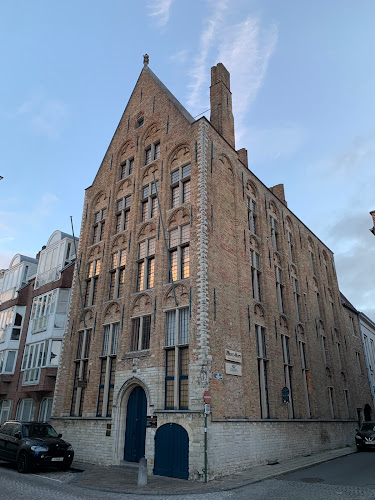
Tucked into the quiet Sint-Anna neighborhood on the eastern edge of Bruges’ medieval core, the Gezellehuis — often called the Gezellemuseum — occupies the modest brick house where Flemish priest-poet Guido Gezelle was born in 1830. Away from the postcard congestion of the Markt and Burg squares, this literary museum offers something rarer in Bruges tourism: a genuinely local, unhurried encounter with the man widely regarded as the father of modern Flemish poetry. It is a stop for readers, language enthusiasts, and anyone curious about the cultural undercurrents that shaped Flanders’ identity separate from its architecture and chocolate shops.
The Gezellehuis is a biographical and literary museum at Rolweg 64, Bruges, set in the birth house of poet Guido Gezelle (1830-1899). Highlights include five thematic exhibition rooms, a walled biological garden, and Jan Fabre’s sculpture ‘The Man Who Inspires Others’ at the entrance. Admission runs roughly €8-10 for adults, and most visits last 45-90 minutes. Arrive weekday mornings for a near-solitary experience.
At A Glance
| Category | Details |
|---|---|
| Address | Rolweg 64, 8000 Bruges, Belgium |
| Operating Hours | Tuesday–Sunday, 9:30 AM–5:00 PM; closed Mondays and select public holidays |
| Price Range / Admission | Adults approx. €8-10; reduced rates for seniors, students, and groups; free with the Musea Brugge Card and for children under 12 |
| Highlights | Gezelle’s birth room, manuscript and correspondence displays, biological vegetable garden, Jan Fabre entrance sculpture, temporary literary art exhibitions |
| Transport/Transit Access | 15-20 minute walk from Markt; bus lines stopping near Kruispoort or Sint-Annakerk; limited street parking, nearest paid garage at Katelijnestraat or Centrum-Station car parks |
Origins, Architectural Evolution & Cultural Significance
Guido Gezelle was born in this modest brick rowhouse on 1 May 1830, at a time when the Sint-Anna quarter housed dockworkers, lacemakers, and tradespeople rather than the merchant elite associated with central Bruges. The house itself reflects the vernacular architecture typical of working-class Bruges dwellings from the early nineteenth century: a narrow street facade, stepped gable roofline, small-paned windows, and a layout organized around a central hallway with rooms branching to either side. Musea Brugge acquired and restored the property specifically to preserve this social context, resisting the temptation to elevate the building into something grander than what it was. The restoration work, completed in phases through the late twentieth and early twenty-first centuries, prioritized structural authenticity — original floor tiles, timber joists, and hearth positions were retained wherever possible, with modern climate control and lighting systems integrated discreetly to protect paper artifacts and photographs.
Gezelle’s cultural weight in Flanders cannot be overstated. As a priest, teacher, and poet writing in West Flemish dialect at a time when French dominated Belgian intellectual life, he became a foundational figure in the Flemish Movement, the cultural and political push for recognition of Dutch-language rights in Belgium. His poetry collections, including ‘Kerkhofblommen’ and ‘Tijdkrans,’ fused close observation of nature with deep Catholic mysticism and linguistic experimentation, influencing generations of Dutch-language poets who followed. The museum’s location in his actual birthplace, rather than a purpose-built institution, grounds this literary legacy in tangible, unglamorous reality — visitors stand in the same rooms where a boy who would reshape Flemish literary consciousness first learned language from his mother, a woman celebrated in his own verse for her rich regional vocabulary.
The museum reopened with a substantially reworked interpretive design in recent years, replacing static glass-case displays with a five-theme narrative structure covering Gezelle’s childhood, his religious vocation, his poetic craft, his role in the Flemish language movement, and his enduring influence. This redesign reflects a broader trend among smaller Bruges museums to compete for visitor attention against the city’s dominant art and chocolate attractions by offering sharper storytelling rather than volume of artifacts.
Signature Highlights & Detailed Offerings
The exhibition unfolds across five connected rooms, each built around a specific theme rather than strict chronology. The first room addresses Gezelle’s early life and the linguistic environment of his childhood home, displaying reproductions of his mother’s letters and early school materials that show his precocious engagement with regional Flemish speech patterns. The second room, focused on his religious formation, includes vestments, ordination documents, and correspondence from his seminary years at Roeselare, where he later taught and mentored students including a young Georges Rodenbach, who would go on to become a significant Symbolist writer himself.
The third and arguably most compelling room houses original manuscript pages and first editions of his major poetry collections, displayed alongside audio stations where visitors can hear select poems read aloud in authentic West Flemish pronunciation — a detail that matters enormously given how central dialect and sound were to Gezelle’s poetic project. The fourth room traces his activism within the Flemish Movement, including printed pamphlets and newspaper clippings from ‘Rond den Heerd,’ the periodical he founded to promote regional folklore and language preservation. The final room addresses his legacy, featuring later editions of his work translated into multiple languages and material documenting his beatification cause within the Catholic Church, an unusual crossover between literary and religious commemoration.
Outside, the garden functions as an extension of the museum’s thematic content rather than a decorative afterthought. Structured as a biological vegetable garden with herb beds and fruit trees, it deliberately echoes the natural imagery — birds, weather, seasonal change, cultivated soil — that runs through Gezelle’s verse. At the entrance stands Jan Fabre’s bronze sculpture ‘The Man Who Inspires Others,’ a striking contemporary counterpoint to the historic house, symbolically bridging nineteenth-century Flemish poetry with twenty-first-century Belgian contemporary art.
Sensory & Spatial Walkthrough
Entering from Rolweg, the transition from a working residential street to the museum interior is immediate and understated — there is no grand lobby, just a modest ticket desk and the compressed, low-ceilinged geometry typical of a nineteenth-century laborer’s house. Natural light filters through small-paned windows in narrow bands rather than broad washes, giving the front rooms a dim, contemplative quality that suits the reflective nature of the content. Deeper into the house, rooms open slightly, and the acoustic environment shifts from the street noise of Rolweg to near-total quiet, punctuated only by the recorded poetry readings looping softly at listening stations.
Material textures throughout favor exposed brick, dark timber beams, and restored plaster walls painted in muted earth tones that avoid competing with the sepia-toned photographs and cream manuscript paper on display. Seating is minimal and functional — a few wooden benches positioned for pausing at key manuscript cases rather than lounging. The garden at the rear offers the sharpest sensory contrast in the entire visit: open sky, birdsong, the smell of turned soil and herbs, and direct sunlight in the midday hours, particularly pleasant between April and September. Morning visits bring cooler, softer light ideal for reading text panels without glare; late afternoon visits catch warmer light through the garden’s fruit trees, better for photography of the Fabre sculpture and the house’s rear facade.
Insider Visitor Strategy & Pro Tips
- Visit on weekday mornings, particularly Tuesday or Wednesday shortly after opening, to experience the rooms without other visitors — this is one of the least crowded museums in central Bruges even during peak summer tourist months.
- Purchase the Musea Brugge Card in advance online if you plan to visit multiple Bruges museums (Groeningemuseum, Arentshuis, and others); it covers admission here and removes the need to queue at the desk.
- Photography without flash is generally permitted in exhibition rooms, but always confirm at the front desk, as manuscript-heavy displays sometimes carry stricter light-sensitivity restrictions.
- Bags larger than a small daypack may need to be left at the entrance due to the narrow room layout; travel light if arriving directly from a train station locker drop.
- Combine your visit with the adjoining Sint-Annakerk (St. Anne’s Church) two minutes away, since both sit outside the main tourist flow and reward visitors willing to walk slightly further from the Markt.
- Check the museum’s temporary exhibition calendar before visiting, as Musea Brugge periodically rotates contemporary literary-art installations through the garden and side rooms.
Curated Half-Day Neighborhood Pairing Itinerary
Start at the Gezellehuis around 9:30 AM when it opens, allowing roughly 75 minutes to move through all five rooms and the garden at an unhurried pace. From the museum entrance on Rolweg, walk two minutes south to Sint-Annakerk, a Baroque parish church known for its dark, richly decorated interior and trompe-l’oeil ceiling paintings — a quiet, atmospheric contrast to the museum’s domestic scale, and typically free to enter. From there, continue roughly eight minutes on foot toward the Jerusalem Chapel (Jeruzalemkerk), an unusual fifteenth-century church built by the Adornes family with a design inspired by the Holy Sepulchre in Jerusalem, complete with a small adjoining lace museum. Close the loop with a ten-minute walk to Sint-Janshuismolen, one of the surviving working windmills along the Kruisvest ramparts, where the elevated grassy embankment offers open-air views over the city’s rooftops and canals — an ideal spot for a packed lunch or a coffee break before continuing back toward the historic center.
Practical Logistics & Universal Accessibility
From Bruges train station, the Gezellehuis sits roughly 2.5 kilometers away, making a direct walk approximately 30-35 minutes; most visitors instead combine it with a walking route through the eastern old town or take a local De Lijn bus toward Kruispoort and walk the remaining five to seven minutes. Street parking near Rolweg is extremely limited and largely reserved for residents; visitors driving into Bruges should use one of the peripheral park-and-ride lots (typically free or low-cost) and take a shuttle bus into the center, or use the paid Centrum-Station underground garage, priced at standard Belgian city rates of roughly €1.50-2.00 per hour.
Regarding accessibility, the historic house presents genuine constraints: original nineteenth-century thresholds, narrow doorways, and at least one interior staircase mean full step-free access is not guaranteed throughout the building. Visitors with mobility devices should contact Musea Brugge in advance to confirm which ground-floor rooms and the garden remain accessible without stairs. Payment at the front desk accepts major cards alongside cash; dress codes are informal, though the museum’s function within a former religious and literary household makes it a poor setting for loud groups or extended phone use. Photography is casual and personal-use oriented rather than commercial by default.
Practical Visitor FAQs
- How long should I plan for a visit to the Gezellehuis? Most visitors need 45 to 90 minutes to see all five exhibition rooms and the garden thoroughly, longer if reading manuscript translations in full.
- Is the museum suitable for visitors who don’t speak Dutch or French? Yes, exhibition panels include English translations, and audio stations offer poem readings alongside translated text, though some nuance of Gezelle’s dialect poetry inevitably loses texture in translation.
- Can I buy tickets on-site or is advance booking required? Same-day tickets are generally available at the door given low visitor volume, though booking online through Musea Brugge in advance avoids any wait during festival periods or school holidays.
- Is the Gezellehuis included in the Bruges City Card or Musea Brugge Card? Yes, it is included under the Musea Brugge Card, which also covers major sites like the Groeningemuseum and Arentshuis.
- Are there facilities for children or families? The museum is compact and content-heavy, better suited to older children with an interest in language or literature rather than young children, though the garden offers a pleasant outdoor break.
- What is the closest major landmark for orientation? Sint-Annakerk (St. Anne’s Church) sits roughly two minutes away and operates as the easiest nearby landmark for directions from central Bruges.