
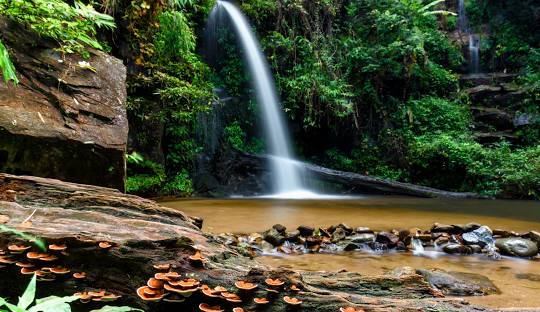
Doi Suthep-Pui National Park protects the forested mountains west of Chiang Mai, with its listed visitor address at RW48+RC4, Sriwichai Alley, Mueang Chiang Mai District, Chiang Mai 50200, Thailand, above the Suthep foothills. Established in 1981, the approximately 261-square-kilometer park combines evergreen forest, waterfalls, mountain trails, and culturally important sites. Travelers come for cooler upland air, views across Chiang Mai, and Wat Phra That Doi Suthep, the Buddhist pilgrimage temple on its eastern slopes.
What to Expect at Doi Suthep-Pui National Park
The park rises from seasonally dry lower forest into cooler evergreen woodland around Doi Pui, its approximately 1,685-meter summit. Huay Kaew Waterfall offers an accessible introduction near the city edge, while Mon Tha Than Waterfall lies deeper inside the forest along a separate access road. Expect shaded walking, stream crossings, birdsong, and slippery rock rather than a single landscaped attraction. Waterfalls generally carry more water during the rainy season; November through February usually brings cooler conditions for walking.
Road 1004 climbs through repeated bends to Wat Phra That Doi Suthep, traditionally founded in 1383. Its gilded chedi, guardian figures, and naga-lined staircase reward a separate stop. Farther uphill, Bhubing Palace, built in 1961 as a royal winter residence, has gardens whose public access depends on royal use and operating arrangements. Doi Pui Hmong village adds another dimension to the mountain circuit through textile stalls and community-run displays. These are distinct stops, not facilities clustered around one park entrance.
- Doi Pui summit forest: Cooler upland vegetation and mountain walking above Chiang Mai’s lowland heat.
- Huay Kaew Waterfall: A lower-slope cascade reached from the area near Chiang Mai Zoo.
- Mon Tha Than Waterfall: Forest cascades approached by a side road branching from the mountain route.
- Wat Phra That Doi Suthep: A gilded Buddhist sanctuary reached by a staircase of roughly 300 steps or an inclined lift.
- Bhubing Palace gardens: Formal royal plantings farther uphill, with separate admission and access arrangements.
Doi Suthep-Pui National Park at a Glance
| Detail | Information |
|---|---|
| Address | RW48+RC4, Sriwichai Alley, Mueang Chiang Mai District, Chiang Mai 50200, Thailand |
| Neighborhood / Area | Suthep foothills and Doi Suthep–Doi Pui mountains, west of Chiang Mai |
| Operating Hours | Daily, 8:30am–4:30pm for park visitor services; individual attractions have separate schedules |
| Admission / Price Range | $; paid access at designated park attractions; temple, palace, and transport charges are separate |
| Recommended Visit Duration | 4–6 hours for a selective mountain circuit |
| Nearest Transit / Parking | Red songthaews from the Chiang Mai Zoo/Huay Kaew Road area; parking at principal visitor stops |
| Official Website & Phone | Official park updates; +66 53 210 244 |
Visiting Tips, Getting There & Nearby Pairings
Start near opening for cooler walking, and choose two or three stops rather than attempting every attraction. Shared red songthaews gather near Chiang Mai Zoo; agree on the destination, return arrangements, waiting time, and fare before departure. There is no rail service up the mountain. Drivers encounter steep bends and limited parking at popular stops, especially on weekends. Carry cash for entrance charges and local transport, drinking water, insect repellent, and shoes with grip. Use designated picnic areas and toilets at developed stops; keep food away from wildlife and leave pets outside the park.
Wheelchair and stroller access is limited by slopes, uneven paths, waterfall steps, and roadside gradients. The temple’s inclined lift bypasses its main staircase, but does not make forest trails accessible; arrange vehicle drop-offs and ask staff about suitable routes. Benches and developed rest areas offer breaks between stops. At the lower Huay Kaew gateway, combine your visit with the Kruba Srivichai monument and Huay Kaew Arboretum, each roughly a 5–15-minute walk depending on your starting point. These foothill pairings are not walking-distance extensions of the upper mountain attractions.
Frequently Asked Questions
What are the opening hours and best visiting time?
Park visitor-service hours are 8:30am–4:30pm daily. Arrive early, especially during the cooler November–February season, and check individual temple, palace, and trail schedules before traveling uphill.
Is admission free, and do I need reservations?
Budget for paid admission at designated park attractions, with separate charges possible at the temple and palace. Ordinary day visits generally do not require reservations; check official park updates for current fees, closures, and camping arrangements.
How long should I spend in the park?
Allow four to six hours for a waterfall, the temple, and one upper-mountain stop. Longer hikes or a leisurely palace-and-village circuit justify a full day, including winding-road travel.
Is the park suitable for families, and what should visitors wear?
Families can combine short waterfall walks with vehicle-based sightseeing, keeping children away from wet rocks and steep edges. Wear covered shoulders and knees at the temple, remove shoes where required, and bring a light layer for cooler elevations.
When planning your Chiang Mai travel guide or browsing verified attractions in Chiang Mai, pair this stop with standout local spots including Wat Jed Yot, Phra Aram Luang, The Empress Chiang Mai Hotel, Huai Kaeo Arboretum, and Wat Phra That Doi Suthep (0.6 km away).


