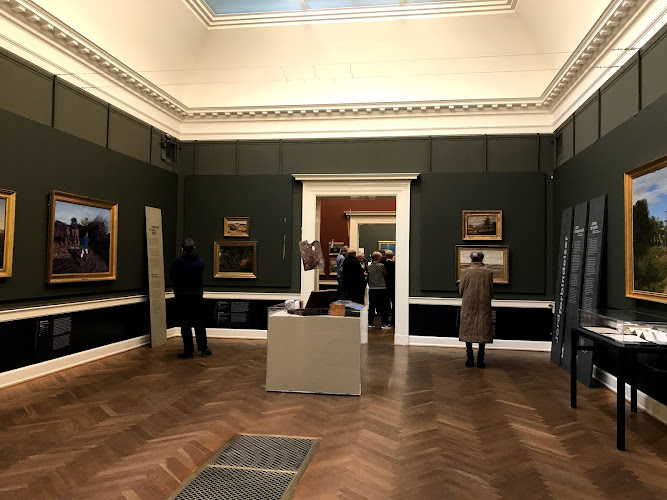
Hirschsprung Collection is a focused museum of Danish art at Stockholmsgade 20, 2100 København, in the Østre Anlæg park area on the edge of Østerbro, Copenhagen, Denmark. Opened in 1911 to present the collection assembled by tobacco manufacturer Heinrich Hirschsprung and his wife Pauline, it traces Danish painting and sculpture from the early 19th century into the early 20th century. Travelers come for an unusually concentrated introduction to the Danish Golden Age, Skagen painters, the Modern Breakthrough and Symbolism in an intimate, purpose-built museum.
What to Expect at Hirschsprung Collection
The permanent collection is arranged as a walk through decisive chapters of Danish art. Begin with the Danish Golden Age, where C.W. Eckersberg’s disciplined studies of perspective and everyday Copenhagen sit alongside Christen Købke’s precise, quietly luminous views. Continue to the later 19th century, when painters increasingly turned toward modern city life, social subjects and outdoor light. The museum’s presentation of the Modern Breakthrough is particularly strong, with work by artists including P.S. Krøyer, Anna Ancher and L.A. Ring.
Look closely at the shift in mood from Skagen’s coastal light to Vilhelm Hammershøi’s restrained interiors and Symbolist painting. The collection also includes sculpture and artist portraits, helping place the paintings within Copenhagen’s artistic circles. Its red-brick, classically ordered 1911 building, designed by H.B. Storck, was made for this collection rather than adapted from another use; the compact rooms encourage slow looking instead of a rushed gallery circuit. From September 18, 2026 through January 24, 2027, the special exhibition Fynboerne. Kunsten frem for alt! examines the Fyn painters and their artistic ideals.
- Danish Golden Age: Major works by C.W. Eckersberg and Christen Købke anchor the early galleries.
- Skagen painters: See key work associated with P.S. Krøyer and Anna Ancher’s treatment of northern light and daily life.
- The Modern Breakthrough: Follow the late-19th-century move toward contemporary subjects and social realism.
- Hammershøi and Symbolism: Seek out the subdued interiors and psychologically charged paintings linked with Vilhelm Hammershøi and L.A. Ring.
- Østre Anlæg setting: Pair the art with a walk through the surrounding park and its ponds after your visit.
Hirschsprung Collection at a Glance
| Detail | Information |
|---|---|
| Address | Stockholmsgade 20, 2100 København, Denmark |
| Neighborhood / Area | Østre Anlæg, on the edge of Østerbro and close to central Copenhagen |
| Operating Hours | Tuesday–Sunday, 10am–5pm; closed Monday. Hirschsprung LATE runs on the last Thursday of each month until 8pm. |
| Admission & Ticket Prices | Paid admission; consult the museum’s official ticket page for current rates and concessions. |
| Recommended Visit Duration | 1.5 to 2 hours |
| Nearest Transit / Parking | Østerport Station is about a 10-minute walk; limited paid street parking is available around Stockholmsgade. |
| Official Website / Phone | hirschsprung.dk / +45 35 42 03 36 |
Visiting Tips, Getting There & Nearby Pairings
Arrive soon after the 10am opening for the calmest experience in the smaller galleries, or use the last-Thursday late opening for extra time after a day of sightseeing. Buy tickets online through the official museum website, especially when a temporary exhibition, guided tour or event is on the calendar. Østerport Station, served by the Metro’s M3 and M4 lines as well as S-trains and regional trains, is the simplest rail arrival; from there, walk southwest through the park. Drivers should expect metered on-street spaces rather than a dedicated museum car park.
The museum provides wheelchair access, a lift connecting gallery levels and an accessible toilet; contact the museum before arrival if you need assistance at the historic entrance. Strollers are manageable indoors, although the building’s rooms and doorways are more compact than those of a large contemporary museum. Combine a visit with Statens Museum for Kunst, roughly 10 minutes away on foot, or walk to the barracks and ramparts of Kastellet in about 15 minutes. Nyboder’s distinctive yellow sailors’ houses are also within an easy 10-minute walk, while the cafés and restaurants around Østerport provide practical lunch options.
Frequently Asked Questions
What are the Hirschsprung Collection opening hours and best time to go?
The museum is open Tuesday through Sunday from 10am to 5pm and is closed on Mondays. The last Thursday of each month has extended Hirschsprung LATE hours until 8pm. For the quietest galleries, arrive near opening on a weekday.
How much are tickets, and should I reserve ahead?
Admission is paid, with current ticket prices and any concession categories published through the museum’s official online ticket service. Advance booking is sensible for guided tours, events and busy temporary-exhibition dates; standard museum entry can also be planned through the official website.
How much time should I allow for the collection?
Allow 90 minutes for the permanent collection, or up to two hours if you want to study the Golden Age rooms, Skagen works, Hammershøi paintings and the current special exhibition at an unhurried pace.
Is Hirschsprung Collection suitable for families and wheelchair users?
It suits families with school-age children and adults interested in art, though the visit is centered on close-looking rather than hands-on displays. Wheelchair users can access the museum, use its lift and accessible toilet; contact staff in advance to arrange the smoothest arrival at the historic building.
When planning your Copenhagen travel guide or comparing verified attractions and museums in Copenhagen, pair this stop with standout local spots including Kiin Kiin, Tivoli Gardens, Botanical Garden, and SMK – Statens Museum for Kunst (0.1 km away).