Acueducto Colonial, also called the Sapantiana Colonial Aqueduct, is a surviving colonial-era waterwork at F2QC+8MX, Choqechaka, Cusco 08002, on the upper edge of the San Blas quarter. Its stone arches and water channel reflect Cusco’s long tradition of hydraulic engineering, where Spanish colonial construction adapted routes and skills established in the Inca capital. Travelers come for a close look at the masonry, a quieter historic stop above the center, and an easy pairing with San Blas and the Cristo Blanco viewpoint.
What to Expect at Acueducto Colonial
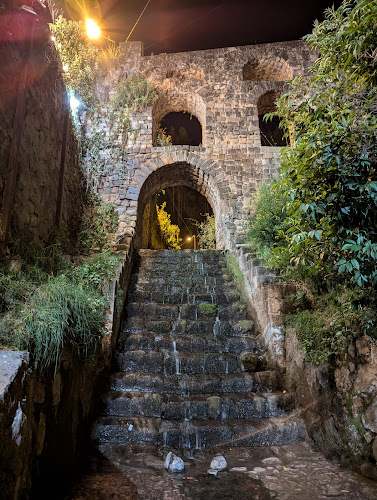
The landmark is a compact open-air structure rather than a ticketed museum: a stone water channel spans a narrow hillside lane on a sequence of rounded masonry arches. Look closely at the contrast between the aqueduct’s later colonial arch construction and Cusco’s older Andean stone-building tradition in the surrounding slopes. The setting is especially compelling because it explains a practical side of the old city—capturing and directing water downhill through a densely built, steep-sided neighborhood.
Approach on foot from San Blas, allowing time for the climb and for photographs from both sides of the lane. There are no formal galleries, interpretive rooms, café, shop, cloakroom, guided-tour desk, or bag check; the appeal is the structure itself and its immediate urban landscape. Personal photography from the public street is straightforward, but avoid climbing on the stonework or blocking the narrow passage. Daylight brings out the texture of the masonry and makes the uneven route much easier to negotiate.
- Colonial stone arches: The aqueduct’s repeated rounded arches create the site’s defining profile and show how the watercourse was carried over the sloping lane.
- Sapantiana water channel: The upper channel is the key engineering feature, recalling the systems that moved water through Cusco’s hillsides and neighborhoods.
- San Blas setting: The structure sits above the historic center amid narrow lanes, plaster-and-adobe houses, workshops, and small neighborhood businesses.
- Street-level viewing: Visitors can appreciate the aqueduct without admission, timed entry, or a prescribed route; it is best treated as a brief stop on a walking circuit.
- Christo Blanco connection: The Mirador desde el Cristo Blanco is about 0.2 km away, making the aqueduct a logical stop before or after city views.
Acueducto Colonial at a Glance
| Detail | Information |
|---|---|
| Address | F2QC+8MX, Choqechaka, Cusco 08002, Peru |
| Neighborhood / Area | San Blas, above Cusco’s historic center |
| Operating Hours | Open-air public landmark; visit during daylight, when the hillside lanes are easiest to navigate. |
| Admission / Price Range | Free to view from the public street; no ticket office or reservation system. |
| Recommended Visit Duration | 20 to 40 minutes, or longer when combined with San Blas and Cristo Blanco. |
| Nearest Transit / Parking | Walk uphill from Plaza de Armas via San Blas; taxis can approach nearby, but there is no dedicated visitor parking. |
| Official Website & Phone | No dedicated visitor website or phone; consult the Municipalidad del Cusco for city information. |
Visiting Tips, Getting There & Nearby Pairings
Start early, ideally between 8 and 10 a.m., for cooler walking conditions and clearer photographs before the lanes become busy. From Plaza de Armas, San Blas is roughly a 10- to 15-minute uphill walk, depending on altitude and pace; take a taxi for the uphill approach if acclimatization is still an issue, then walk downhill through San Blas afterward. Cusco has no metro or tram serving the site. Private cars are impractical on the narrow streets, and visitors should not expect an on-site lot or formal garage.
The route has steep grades, cobbles, irregular paving, and narrow pedestrian space, so it is not a reliably step-free attraction. Wheelchair users and travelers with limited mobility will need assistance and may find a street-level view from the closest accessible drop-off more realistic than a full walking circuit; there are no dedicated restrooms or seating at the aqueduct. Pair the stop with the stone lanes and artisan shops around Plaza San Blas, the Cristo Blanco overlook, and the Twelve-Angled Stone on Hatun Rumiyoc, each reachable within roughly 5 to 15 minutes on foot depending on route and elevation.
Frequently Asked Questions
What are the best hours to visit Acueducto Colonial?
As an outdoor public-street landmark, it is best visited in daylight. Morning is the most comfortable time for the uphill walk and gives better visibility on uneven surfaces; avoid arriving after dark, when the surrounding lanes can be difficult to navigate.
Is there an entrance fee or reservation requirement?
No admission fee or advance reservation is required to see the aqueduct from the public street. There is no ticket counter, formal guided-tour schedule, or visitor facility, though licensed Cusco walking guides may include it in private itineraries.
How much time should I allow for the aqueduct?
Allow 20 to 40 minutes to examine the arches, take photographs, and absorb the setting. Budget 1.5 to 2 hours if continuing through San Blas and walking to the Cristo Blanco viewpoint or back down to Plaza de Armas.
Is Acueducto Colonial suitable for families and wheelchair users?
Families with confident walkers can enjoy this short historical stop, but keep children close on the narrow, sloped lanes. The steep cobbles and lack of a dedicated step-free route make independent wheelchair access difficult; sturdy shoes are advisable for all visitors.
When planning your Cusco travel guide or browsing verified attractions in Cusco, pair this stop with standout local spots including Museo de Arte Religioso, Shopping Center "El Sol", Tambomachay, and Encantada Casa Boutique Spa Hotel (0.2 km away).