
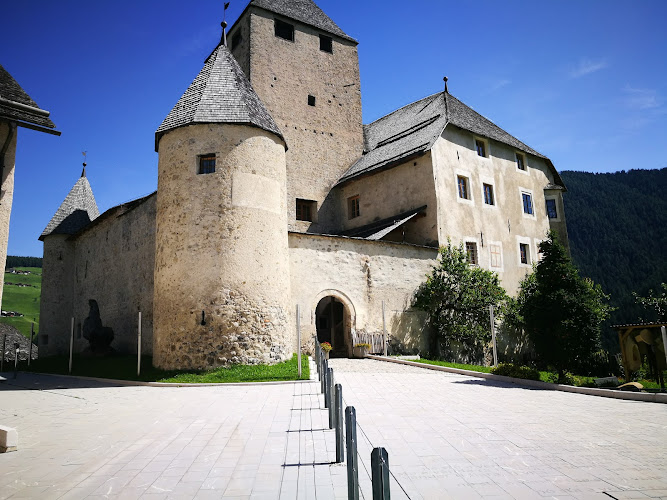
Museum Ladin is a museum of Ladin language, history, and culture at Str. Tor 65, 39030 San Martin de Tor, also called San Martino in Badia, in South Tyrol’s Val Badia. Opened in 2001 inside the medieval Ciastel de Tor above the village center, it explains the people behind the Dolomites’ Ladin place names, farming traditions, and distinctive language. Travelers come for the castle setting and an introduction to mountain communities whose history crosses today’s provincial boundaries.
What to Expect at Museum Ladin
Ciastel de Tor was first documented in 1230 and became an administrative center for the prince-bishops of Bressanone. Its square keep, enclosed courtyard, and residential ranges make the building part of the exhibition rather than a neutral container. Inside, the permanent displays connect archaeology, geology, settlement, language, and economic change. The central story follows the Ladin-speaking communities of Val Badia, Val Gardena, Val di Fassa, Livinallongo, and the Ampezzo area, explaining how shared linguistic roots developed alongside distinct local identities.
Allow time for the language displays rather than treating the museum solely as a castle tour. Ladin is a Romance language shaped by the encounter between Latin and older Alpine populations; the interpretation places it within everyday life, education, and regional identity. Other sections examine mountain agriculture, craftsmanship, and tourism’s transformation of the valleys. Begin with the introductory historical material, then follow the exhibition sequence before returning to the courtyard. Ask at reception about audio interpretation and guided visits in your preferred language. The bookshop carries publications on Ladin subjects, while the modern museum building includes a café and temporary-exhibition space.
- Medieval Ciastel de Tor: A fortified hilltop residence with a square keep and courtyard overlooking the village and surrounding mountains.
- Ladin language: Displays explain the language’s origins and its place within the five principal Ladin valleys.
- Archaeology and settlement: Exhibitions trace human occupation and the development of communities in the Dolomites.
- Mountain livelihoods: Farming, craft production, and tourism reveal how families adapted to changing Alpine economies.
- Geology of the Dolomites: Geological interpretation connects the surrounding landscape with the region’s much longer natural history.
Museum Ladin at a Glance
| Detail | Information |
|---|---|
| Address | Str. Tor 65, 39030 San Martino in Badia BZ, Italy |
| Neighborhood / Area | Castle hill above San Martin de Tor village, Val Badia |
| Operating Hours | May 1–November 1: Tuesday–Sunday, 10:00–18:00; Monday closed. Seasonal closure outside these dates. |
| Admission / Price Range | Paid admission; $ budget sightseeing tier. Consult official ticket information for current rates and concessions. |
| Recommended Visit Duration | 1.5 to 2 hours |
| Nearest Transit / Parking | Bus 460 along Val Badia, connecting with local services toward San Martino; visitor parking near the castle approach. |
| Official Website & Phone | Official tickets and visitor information; +39 0474 524062 |
Visiting Tips, Getting There & Nearby Pairings
Arrive near 10:00 for an unhurried circuit, especially if you want to read the historical interpretation closely. Check the seasonal calendar before traveling: this is not a year-round indoor alternative. From Brunico, bus 460 runs along Val Badia; use the official Südtirolmobil journey planner for connections into San Martino and the final uphill approach. Drivers should follow signs for Museum Ladin/Ciastel de Tor and use designated visitor parking rather than village residential spaces.
The hilltop approach and historic castle surfaces deserve consideration for wheelchairs, walking aids, and strollers. Contact reception about step-free access and the suitable exhibition route before arrival; do not assume every historic section has identical access. Ask staff about large-bag storage and photography restrictions before entering the galleries. For a nearby pairing, walk downhill to the parish church of San Martino and the village center, roughly 10–15 minutes away; allow longer for the uphill return. The village also houses the Istitut Ladin Micurá de Rü, an important center for Ladin language research.
Frequently Asked Questions
When is Museum Ladin open?
The published season runs May 1–November 1, Tuesday–Sunday, 10:00–18:00, with Mondays closed. Opening time works well for a focused visit before afternoon sightseeing.
Are tickets or advance reservations required?
Admission is paid; check the official website for current ticket categories and concessions. Contact the museum ahead for guided visits or organized groups.
How long should I spend here?
Budget 1.5–2 hours for the permanent displays and castle setting. Add time for temporary exhibitions, the bookshop, or a café stop.
Can families visit with a dog?
Families can combine the cultural displays with a shorter castle-focused visit. Pets are not permitted in the main museum, but are welcome outdoors and in the newer building’s café and temporary-exhibition area.
Travelers exploring Dolomites often pair this stop with nearby highlights including Messner Mountain Museum Firmian.


