
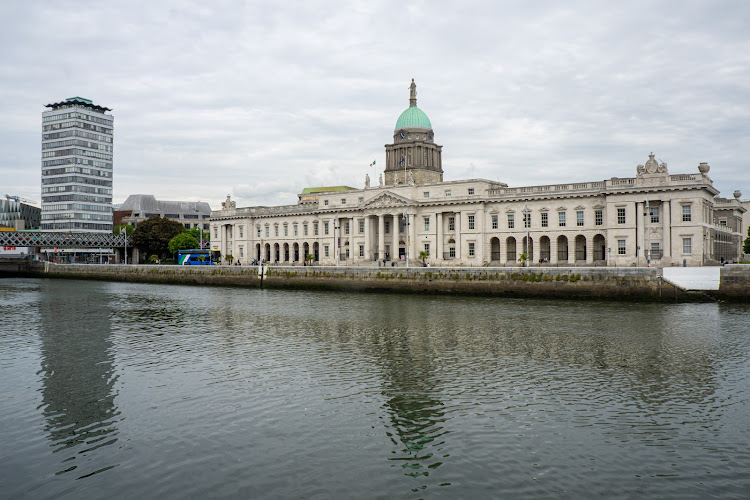
The Custom House Visitor Centre is an essential Irish heritage museum and architectural landmark located on Custom House Quay along the River Liffey in Dublin, Ireland. Completed in 1791 to the neoclassical designs of master architect James Gandon, this iconic Portland stone palace showcases the dramatic 230-year history of Dublin’s port, the legendary River God keystones sculpted by Edward Smyth, and the building’s dramatic burning during the 1921 Irish War of Independence.
At A Glance: Custom House Visitor Centre Facts
| Heritage Metric | Architectural Specification & Visitor Fact |
|---|---|
| Address & Location | Custom House Quay, North Dock, Dublin 1, D01 W6X0, Ireland (North bank of River Liffey) |
| Operating Hours | Tuesday–Sunday: 10:00 AM – 5:30 PM (Last admission at 4:45 PM) | Closed Monday |
| Admission Tickets | Adults: €8.00 | Seniors (60+): €6.00 | Children (12–17) & Students: €4.00 | Family: €20.00 |
| Architectural Master | Designed by English-born architect James Gandon (constructed 1781–1791) |
| Sculptural Masterpieces | 14 River God keystones representing Ireland’s rivers, carved by Edward Smyth |
| Transit & Luas | Luas Red Line (Busáras or George’s Dock stop) & Tara Street DART Station (3-min walk) |
James Gandon’s Neoclassical Masterpiece on the Liffey
During the late 18th century, Dublin was the second city of the British Empire, experiencing a golden age of Georgian civic building. In 1781, the Right Honourable John Beresford, First Commissioner of Revenue, bypassed city merchants to commission visionary neoclassical architect James Gandon to design a monumental new Custom House downriver from the medieval center. Constructed from gleaming English Portland stone and Irish granite over ten arduous years at a staggering cost of £200,000, it stands as Gandon’s undisputed masterpiece.
The south facade facing the River Liffey extends an astonishing 114 meters (375 feet), crowned by a central Doric hexastyle portico and a soaring 38-meter dome topped by an allegorical statue of Commerce. Following an extensive multi-year restoration led by the Office of Public Works (OPW), the visitor centre opened to reveal the building’s dramatic interior architecture and political history.
Edward Smyth’s Legendary River God Keystones
One of the most celebrated artistic treasures of the Custom House is its series of 14 carved stone keystones positioned above the ground-floor arches, sculpted by master Irish stone carver Edward Smyth:
- The 14 River Gods: Smyth personified the major rivers of Ireland as powerful aquatic deities. Thirteen are depicted as rugged, bearded male river gods adorned with symbolic foliage and wildlife—including the Shannon, Barrow, Boyne, Lee, Suir, Nore, and Bann.
- The Anna Livia (River Liffey): The sole female keystone, representing the River Liffey (Anna Liffey), sculpted with cascading hair interwoven with seaweed and ocean pearls, gazing serenely down upon the waters she commands.
- Pediment Allegories: The grand south pediment sculpture commemorates the Friendly Union of Great Britain and Ireland, flanked by figures of Neptune driving away Famine and Despair.
The Burning of the Custom House: May 25, 1921
A central, emotionally stirring wing of the museum chronicles the fateful day of May 25, 1921, during the height of the Irish War of Independence. Over 100 volunteers of the Dublin Brigade of the Irish Republican Army (IRA)—under orders from Michael Collins and Éamon de Valera—surrounded and entered the Custom House, armed with paraffin and incendiary bombs.
Their objective was to paralyze the British administrative tax apparatus in Ireland. The resulting catastrophic inferno burned uncontrollably for five days, collapsing Gandon’s majestic copper dome and destroying centuries of historical tax, probate, and maritime records. The museum’s interactive exhibition brings this pivotal moment to life through eyewitness accounts, historical weapons, dramatic photographs of the blazing dome, and British newsreel footage.
Exploring Dublin’s North Quays & Docklands
The Custom House anchors one of Dublin’s most fascinating historical and modern walking routes:
Walk two minutes east along Custom House Quay to view the haunting bronze figures of the Famine Memorial, sculpted by Rowan Gillespie to commemorate the devastating Great Famine of 1845–1849. Continue another 3 minutes to board the historic Jeanie Johnston tall ship replica, or cross the modern harp-shaped Samuel Beckett Bridge (designed by Santiago Calatrava) to explore the revitalized Silicon Docks on the south bank.
Frequently Asked Questions About the Custom House
Is the Custom House covered by the Heritage Ireland OPW Heritage Card?
Yes. Holders of the OPW Heritage Card enjoy complimentary free admission to the Custom House Visitor Centre and all its exhibitions.
Are guided tours available?
Yes. The OPW offers informative 45-minute guided tours led by professional historians at regular intervals throughout the day, which can be booked upon arrival at the ticket desk.
Which transit stop is closest?
Tara Street Station (DART commuter rail) is directly across the river via the Matt Talbot Bridge (3-min walk), while the Luas Red Line Busáras stop is just 150 meters to the north.
The Architectural Genius of James Gandon
English architect James Gandon (1743–1823) arrived in Dublin in 1781 under conditions of extreme secrecy. Dublin’s wealthy merchants, whose businesses were centered around the old Custom House upriver near Essex Bridge, fiercely opposed moving maritime taxation downriver and threatened physical violence against Gandon. Protected by armed guards hired by Commissioner John Beresford, Gandon broke ground on the swampy mudflats of the North Wall, pioneering a revolutionary foundation system using sunken timber rafts and Irish granite blocks to support the colossal weight of the Portland stone palace.
A Curated Dublin Liffey Quays Walking Tour
The Custom House anchors one of Dublin’s most historically rich riverside walking routes:
- Stop 1: The Custom House Visitor Centre: Spend an hour touring the neoclassical galleries, viewing the detailed scale models of Gandon’s original dome, and examining artifacts recovered from the 1921 inferno.
- Stop 2: The Famine Memorial & Jeanie Johnston: Walk 200 meters east along Custom House Quay to view Rowan Gillespie’s haunting bronze sculptures of starving Irish emigrants walking toward the famine ships. Board the Jeanie Johnston famine ship replica to experience 19th-century transatlantic voyages.
- Stop 3: EPIC The Irish Emigration Museum: Continue 3 minutes east into the restored 1820 stone vaults of the CHQ Building to visit EPIC, an interactive museum chronicling the worldwide impact of the Irish diaspora.
- Stop 4: Samuel Beckett Bridge & Silicon Docks: Conclude your walk at the harp-shaped Samuel Beckett cable-stayed bridge, enjoying sweeping views of Dublin’s modern docklands architecture reflecting in the Liffey.
The Restoration Triumph of the 1920s Dome
Following the devastating fire of May 1921, the Irish Free State government faced the dilemma of whether to demolish the ruins or rebuild Gandon’s masterpiece. In 1926, the newly formed Office of Public Works undertook an ambitious reconstruction under architect T.J. Byrne. The collapsed copper dome was replaced with a subtly different profile constructed using darker Irish Ardbraccan limestone rather than English Portland stone, deliberately commemorating the building’s rebirth as an institution of sovereign, independent Ireland.


