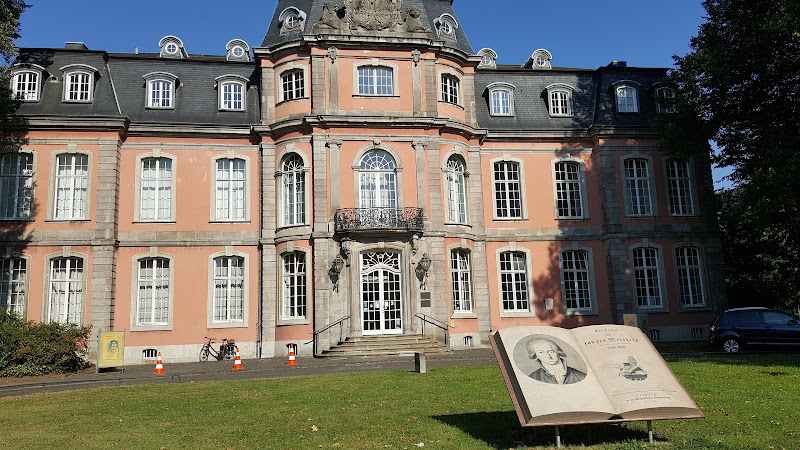
Stadterhebungsmonument is a monumental bronze relief by Düsseldorf sculptor Bert Gerresheim at Marktplatz, 40213 Düsseldorf, Germany, on the edge of the Altstadt beside Burgplatz and the Rhine. Unveiled in 1988 for Düsseldorf’s 700th anniversary, it commemorates the city’s elevation in 1288, following Count Adolf V of Berg’s victory at the Battle of Worringen. Travelers come to decipher its densely modeled medieval scenes, then continue easily to the Rhine promenade, Schlossturm and St. Lambertus Basilica.
What to Expect at Stadterhebungsmonument
This is not a conventional statue with one viewpoint. Gerresheim conceived the work as a large, walk-around historical narrative in bronze, packed with interlocking human figures, horses, weapons, ecclesiastical imagery and symbolic details. Its principal story is the Battle of Worringen on 5 June 1288, a conflict whose political outcome allowed Adolf V of Berg to grant Düsseldorf town rights on 14 August 1288. The repeated date “1288” is worked into the monument and its surrounding setting, rewarding a slow circuit rather than a quick photograph.
Look for the scenes linked to the city charter and to St. Lambertus: the parish church was raised to a collegiate foundation in the same historical moment. The monument’s expressive, crowded modeling gives medieval history a deliberately dramatic, almost theatrical character rather than presenting a polished civic plaque. It stands in an open public space between Marktplatz and Burgplatz, so the experience includes the surrounding Altstadt architecture, the former castle tower of the Schlossturm and the nearby riverfront. There is no interior collection or timed route; the sculpture itself is the exhibit.
- Battle of Worringen narrative: Study Gerresheim’s forceful battlefield figures, recalling the 1288 victory that changed the region’s political balance.
- City-rights charter: Find the references to Adolf V of Berg’s granting of town rights to Düsseldorf on 14 August 1288.
- St. Lambertus story: The relief also refers to the elevation of the parish church to a collegiate foundation.
- Bronze details from every angle: Walk around the sculpture to notice faces, horses, weapons, lettering and tightly layered relief work.
- Altstadt setting: Pair the monument with Burgplatz, the Schlossturm and the Rhine embankment promenade a few steps away.
Stadterhebungsmonument at a Glance
| Detail | Information |
|---|---|
| Address | Marktplatz, 40213 Düsseldorf, Germany |
| Neighborhood / Area | Altstadt, at Burgplatz near the Rhine |
| Operating Hours | Outdoor public monument; accessible 24 hours daily |
| Admission & Ticket Prices | Free public admission; no tickets or reservations required |
| Recommended Visit Duration | 15 to 30 minutes; allow longer when combining nearby landmarks |
| Nearest Transit / Parking | Heinrich-Heine-Allee U-Bahn station, about a 5-minute walk; Carlsplatz parking garage is roughly 8 to 10 minutes on foot |
| Official Website / Phone | City of Düsseldorf monument information / +49 211 172020 |
Visiting Tips, Getting There & Nearby Pairings
Visit in the morning or around midday if you want space to inspect the relief and photograph the bronze before Altstadt dining and nightlife traffic builds. The work is outdoors, illuminated by changing natural light, and can be seen at any hour; evening visits are best combined with a walk along the Rhine. There are no tickets, entry desk or booking system. From Heinrich-Heine-Allee, served by several U-Bahn lines, walk west through the Altstadt toward Marktplatz and Burgplatz. Drivers should use a central garage such as Carlsplatz and finish on foot, as the immediate old-town streets are pedestrian-focused.
The monument is in an open square and can be viewed from surrounding pedestrian paths, making it straightforward for strollers and most wheelchair users to approach. However, expect historic paving, including cobbles and uneven stone joints around the Altstadt; a companion can be useful for anyone who finds rough surfaces difficult. There are no dedicated monument facilities, elevators or on-site restrooms. Within a 5- to 15-minute walk, visit the Schlossturm, home to Düsseldorf’s Maritime Museum; admire the leaning spire of St. Lambertus Basilica; or follow the Rheinuferpromenade south toward Carlsplatz Market. Marktplatz and nearby Bolkerstraße offer plentiful cafés, breweries and casual Altstadt dining.
Frequently Asked Questions
When is the best time to visit Stadterhebungsmonument?
The outdoor monument is accessible 24 hours a day. Morning is the most comfortable time to study its small bronze details, while late afternoon or evening works well for a Rhine and Altstadt walk.
Does Stadterhebungsmonument require tickets or reservations?
No. It is a free public monument on Marktplatz, with no admission charge, timed entry or reservation requirement.
How much time should I budget for the monument?
Allow 15 to 30 minutes to walk around the relief and identify its battle, charter and church references. Add an hour or more for Burgplatz, the Schlossturm and the Rhine promenade.
Is Stadterhebungsmonument suitable for families and wheelchair users?
Yes, its dramatic figures can engage children and it is viewable from public pedestrian space. Wheelchairs and strollers can approach, but historic cobbles and uneven paving in the Altstadt may require care.
When planning your Dusseldorf travel guide or browsing verified attractions in Dusseldorf, pair this stop with standout local spots including Manufactum Brot & Butter, Restaurant FRITZ's FRAU FRANZI, [a]dress kitchen&bar, and Schwan Restaurant Düsseldorf Altstadt (nearby).