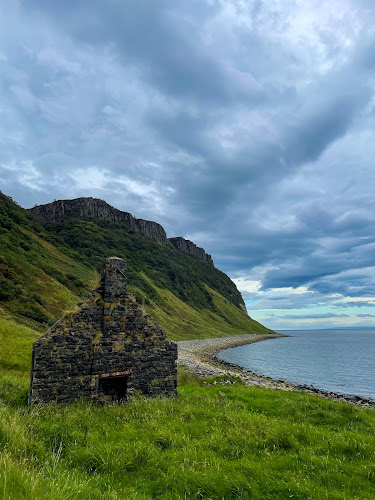
Talisker Waterfall is a wild coastal cascade at the northern end of Talisker Bay on Skye’s Minginish peninsula. Fresh water drops over dark volcanic cliffs directly beside an Atlantic-facing beach, creating a compact but memorable meeting of falling water, surf, black sand and exposed rock. This is not a built attraction: the reward is a raw shoreline landscape reached on foot through grazing country.
Set in southwest Skye near Talisker House, the waterfall feels distinctly removed from the island’s busier roadside sights. The approach follows an estate track toward the bay, then opens onto a broad sweep of dark sand, stones and boulders. Across the water, a sea stack helps frame the southern side of the bay; to the right when facing the sea, the waterfall cuts down the northern cliffs.
Standout Highlights & What Not to Miss
Talisker Waterfall works best as a landscape walk rather than a box-ticking photo stop. Conditions shape the experience: recent rain can give the cascade greater force, while wind can blow its falling water into mist. Take time to read the full setting from the beach, where the waterfall, cliff layers, sea and changing shoreline are visible together.
- The cliffside cascade: View it from the open beach for the clearest sense of its scale and its striking drop over dark rock. Avoid trying to stand beneath the cliffs, where terrain may be unstable.
- Talisker Bay’s dark shore: The mix of dark sand, rounded stones and larger boulders is central to the scene. Its walkable width changes with the tide, so leave room for the sea’s advance.
- Volcanic geology: The cliffs are part of Skye’s ancient lava landscape, formed around 60 million years ago. The dark rock gives photographs a powerful contrast with white water and pale foam.
- The southern sea stack: Look across the bay to pick out this offshore landmark. It adds depth to wide landscape compositions and makes the beach feel larger than the waterfall alone.
- The approach through countryside: Sheep, gates, puddles and open farmland are part of the character. Keep to the established track, close gates as you find them and give occupied homes their privacy.
Visitor Strategy & Planning Snapshot
| Planning Factor | What to Expect | Practical Strategy |
|---|---|---|
| Ideal Arrival Window | The bay is most atmospheric when light, cloud and sea conditions show the texture of the cliffs and sand. | Arrive with enough daylight for the walk back; photographers may prefer softer light, but prioritize safe footing over a particular image. |
| Typical Time Needed | A visit commonly takes 1.5 to 2 hours, including the walk to the shore and time on the beach. | Allow extra time for slow ground, weather pauses and exploring the bay rather than treating the waterfall as a five-minute stop. |
| Booking / Queue Reality | This is free countryside access rather than a ticketed attraction, with no formal visitor infrastructure at the waterfall. | No advance booking is usually part of the visit; park considerately, avoid blocking access and be self-sufficient. |
| Terrain & Accessibility | The estate-track approach includes loose stones and sand, and there is no continuous smooth wheelchair route to shore viewpoints. | Wear supportive footwear and expect uneven surfaces. Those needing level, step-free access may find this setting unsuitable. |
| Weather / Seasonal Fit | Rain can strengthen the fall, while wind, mud and exposed beach conditions can make the outing more demanding. | Use waterproof layers, check conditions before setting out and turn back if wind, visibility or the sea makes the beach feel unsafe. |
Honest Trade-Offs: Best For vs. Who Might Skip
This is an excellent choice for coastal photographers, geology-minded visitors, countryside walkers and outdoor-loving families comfortable with an informal route. It delivers far more atmosphere than facilities: there are no landscaped paths, viewing platforms or guaranteed dramatic flow. The walk is relatively gentle in profile, but loose ground, wet patches, wind and a beach setting demand attention. Visitors seeking a quick roadside viewpoint, a polished attraction or reliable step-free access should choose a more accessible Skye stop. Families should keep children away from cliff bases, slippery rocks and incoming water.
Neighborhood Context & How to Pair Your Visit
Build Talisker Waterfall into a slower southwest-Skye outing rather than rushing it between distant island landmarks. The natural pairing is Talisker Bay itself: walk the estate track out, take in the waterfall from the northern end, then give the beach time before retracing your route. The setting is not an urban, shop-to-shop neighborhood, so bring what you need, leave no trace and plan onward driving around changing weather. It is especially satisfying as a dedicated coastal walk on a Minginish day, when the journey through open countryside is treated as part of the destination.
When planning your Isle of Skye travel guide or browsing verified attractions in Isle of Skye, pair this stop with standout local spots including Bearreaig Bay, Dunvegan Castle & Gardens, Rigg Viewpoint, and Talisker Bay Beach (0.8 km away).