
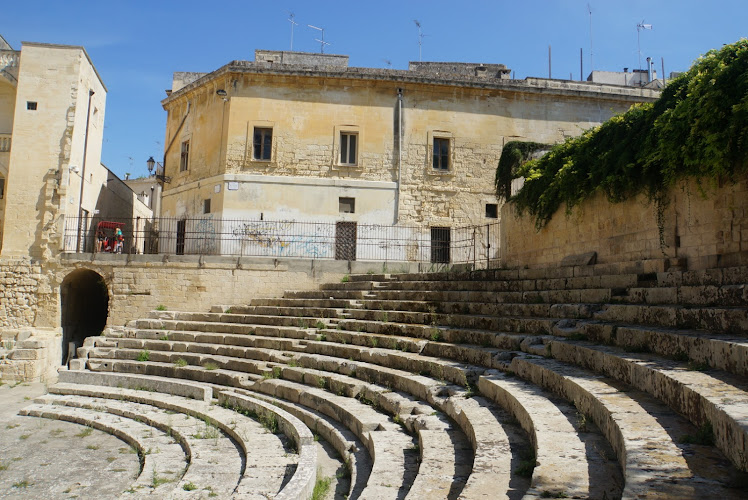
Museo del teatro romano is the intimate archaeological access point for Lecce’s Roman Theatre at Via degli Ammirati 5, 73100 Lecce, in the baroque old town. Discovered unexpectedly in 1929 beneath the gardens of Palazzo D’Arpe and Palazzo Romano, the Augustan-era monument reveals how Roman performance culture was built directly into the limestone heart of Salento; travelers come for close views of its cavea, orchestra and stage behind the surrounding historic palazzi.
What to Expect at Museo del teatro romano
This is an archaeological visit rather than a conventional museum of vitrines and large galleries. The focal point is the exposed semicircular theatre itself, cut into a bank of local rock and faced in opera quadrata, carefully squared stonework associated with Roman construction. Its outer cavea measures about 40 metres across and its inner diameter is 19 metres. The monument is generally assigned to the Augustan period, although its precise date remains uncertain.
Look closely at the seating plan. Five radial staircases divide the cavea into six wedge-shaped cunei, each with 12 tiers; many of the surviving steps have been restored. A narrow covered passage leads into the orchestra, whose rectangular white-limestone slabs marked the space used by the chorus. Three broad, semicircular steps in front once accommodated movable seats for local notables, while the low balteus wall separated privileged seating from the performance area. Beyond it, identify the curtain channel and the 30-metre-wide stage, set 0.70 metres above the orchestra and extending 7.70 metres deep.
- Augustan theatre: A Roman monument in Lecce’s historic core, dated broadly to the Augustan era despite uncertain chronology.
- Rock-cut cavea: The 40-metre outer semicircle demonstrates how the auditorium was carved into the local stone.
- Six seating wedges: Five radial stairways organize the audience tiers into six clearly legible cunei.
- White-limestone orchestra: Rectangular paving slabs preserve the ceremonial and musical heart of the theatre.
- Stage mechanics: The curtain channel, balteus and 30-metre stage make the monument’s working layout unusually easy to read.
Museo del teatro romano at a Glance
| Detail | Information |
|---|---|
| Address | Via degli Ammirati 5, 73100 Lecce LE, Italy |
| Neighborhood / Area | Centro Storico, near Piazza Sant’Oronzo |
| Operating Hours | Mon, Tue 10am–2pm and 3:30–7:30pm; Wed and Fri 3:30–7:30pm; Thu and Sat 10am–2pm; closed Sun |
| Admission / Price Range | Paid admission; $ budget tier. Contact the operator for the current rate. |
| Recommended Visit Duration | 45 to 60 minutes |
| Nearest Transit / Parking | Lecce railway station is about a 15-minute walk; use the historic-centre perimeter car parks, then continue on foot. |
| Official Website & Phone | Itersalento Museo Teatro Romano; +39 0832 279196 |
Visiting Tips, Getting There & Nearby Pairings
Arrive at the opening of either daily session, especially in summer, when the compact archaeological area is quieter and the pale stone photographs more evenly before the strongest afternoon light. Check access and any guided-visit arrangements by phone before setting out, particularly on Wednesday and Friday, when opening is limited to the afternoon. The centre’s lanes are best approached on foot: from Lecce station, walk north through the old town for roughly 1.2 kilometres; drivers should leave the car at a perimeter car park rather than attempt the restricted central streets.
The venue is a historic excavation with uneven stone, narrow circulation and stepped seating. The theatre’s radial stairs and tiered cavea are not step-free, so wheelchair users, visitors with limited mobility and families using strollers should ask in advance about the most suitable viewing point and assistance. Pair the visit with Piazza Sant’Oronzo and its much larger Roman Amphitheatre, about five minutes away, then continue to the carved-paper workshops on Via Vittorio Emanuele II or the Basilica di Santa Croce, roughly 10 minutes on foot. Museo Faggiano, another layered archaeological house museum, is also an easy walk south.
Frequently Asked Questions
When is Museo del teatro romano open, and what is the best time to go?
It opens Monday and Tuesday morning and afternoon, Wednesday and Friday afternoon, and Thursday and Saturday morning; it is closed Sunday. The first hour of an opening session is the strongest choice for an unhurried look at the stonework.
How much are tickets, and do I need a reservation?
Entry is paid and sits in the $ budget category. Confirm the current ticket rate and whether a guided or timed visit is being offered directly with Itersalento, particularly for groups.
How long should I allow for the Roman Theatre?
Allow 45 to 60 minutes to examine the cavea, orchestra, seating divisions and stage remains at a considered pace. It works well as a focused stop between Piazza Sant’Oronzo and Lecce’s baroque churches.
Is the site suitable for wheelchairs and children?
Children interested in ancient spectacle will find the visible stairways, orchestra and stage easy to understand, but close supervision is essential around the stepped ruins. The excavation includes uneven surfaces and stairs, so it is not fully step-free; contact the venue before visiting with a wheelchair or stroller.
When planning your Lecce travel guide or comparing verified attractions and archaeological museum in Lecce, pair this stop with standout local spots including Palazzo Luce, Basilica di Santa Croce, La Vecchia Osteria da Totu, and MUST (Museo Storico Città di Lecce) (nearby).


