
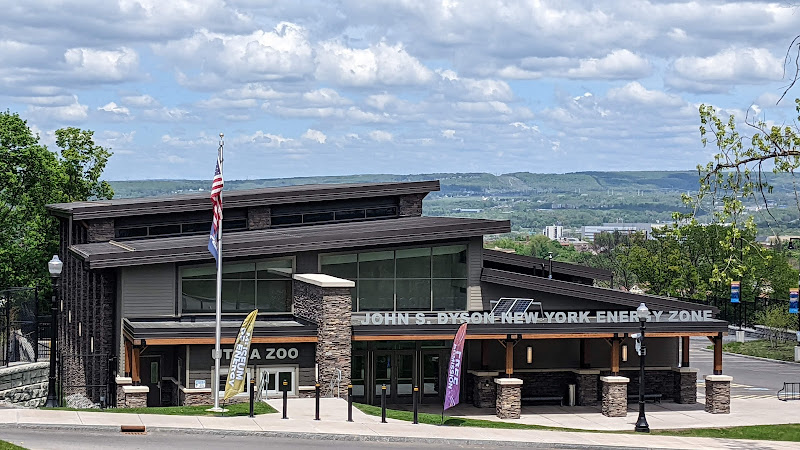
NY Energy Zone is a compact, hands-on electricity discovery center in Utica’s Roscoe Conkling Park area, beside the Utica Zoo. Operated by the New York Power Authority, it turns an enormous everyday system—the generation, movement and management of electricity—into an approachable indoor visit. The focus is not on a collection of historic objects alone, but on interactive explanations of how power reaches homes, businesses and communities across New York.
This is an especially useful stop for families with school-age children, student groups and travelers looking for a rain-proof activity with a real local connection. A 3D theater, build-oriented activities and a control-room simulation give the visit momentum, while the galleries connect New York’s electrical past to the present-day grid and questions about the energy future. Plan on a focused visit rather than an all-day museum outing.
Standout Highlights & What Not to Miss
The strongest part of NY Energy Zone is its ability to make invisible infrastructure tangible. Rather than requiring prior science knowledge, the exhibits work from familiar questions: Where does electricity come from? How does it travel? What happens when demand changes? Give children time to try the stations themselves, and let the theater provide the larger story before digging into the details.
- 3D theater introduction: Begin here if possible. The film supplies historical and scientific context for the galleries and helps visitors see the subsequent activities as pieces of one statewide electricity story.
- New York electricity history: Trace the development of electrical power in the state, then use that background to understand why generation, transmission and grid coordination matter today.
- Build-your-own power structures: The construction-focused activity turns engineering ideas into a practical challenge. It is a good place for children to experiment, compare approaches and talk through why structures need stability.
- Control-room simulation: Take the operator’s perspective on a system that must continuously balance electricity supply and demand. This is the clearest bridge between a household light switch and the complex network behind it.
- Energy-future conversations: Look beyond the hands-on novelty to the questions raised by changing energy sources and infrastructure. Adults and older students can get more from the visit by discussing trade-offs rather than rushing station to station.
Visitor Strategy & Planning Snapshot
| Planning Factor | What to Expect | Practical Strategy |
|---|---|---|
| Ideal Arrival Window | An indoor, self-directed attraction that works well as a morning or afternoon anchor. | Pair it with nearby park or zoo time; choose the indoor portion when weather is least inviting. |
| Typical Time Needed | Most visitors need 60 to 90 minutes for the theater and core interactive galleries. | Allow extra time for children who want repeat turns at hands-on stations. |
| Booking / Queue Reality | Its strongest audience includes schools and organized groups, which may shape the atmosphere. | Groups should arrange ahead; independent visitors should verify current entry and program details before setting out. |
| Terrain & Accessibility | The experience is indoors and centers on galleries and a theater, with seating and mobility needs varying by activity. | Visitors needing specific mobility, stroller or theater-seating support should contact the venue in advance. |
| Weather / Seasonal Fit | This is a reliable rainy-day or cold-weather complement to outdoor Utica plans. | Use it as the flexible indoor element of a zoo-and-park itinerary, especially when conditions change. |
Honest Trade-Offs: Best For vs. Who Might Skip
NY Energy Zone is best for curious kids, educators, science-minded adults and anyone who appreciates an activity with a clear educational purpose. It is also a smart value-oriented choice, with admission and parking described as free. The trade-off is scope: this is a specialized interpretation center, not a large general science museum with dozens of unrelated galleries. Travelers seeking art, a broad history survey, animal encounters or a long half-day attraction should pair it with another stop. Very young children may enjoy the visual and tactile elements, but school-age visitors are more likely to grasp the ideas behind the games and simulations. Those already deeply familiar with power systems may find the content introductory, though the New York grid context remains the distinguishing angle.
Neighborhood Context & How to Pair Your Visit
Think of the Energy Zone as part of a Roscoe Conkling Park outing rather than an isolated destination. Its position beside Utica Zoo makes the two an easy same-area pairing: use the museum to add an indoor learning segment before or after time outdoors, then adjust the order according to the weather and your group’s energy level. Families can make a satisfying mini-itinerary by starting with the theater and interactive exhibits, taking a park break, and continuing with the zoo. For visitors exploring Utica more broadly, the short, focused format leaves room for a meal or another neighborhood stop without forcing a rushed day.
When planning your Utica travel guide or comparing verified attractions and museums in Utica, pair this stop with standout local spots including Quality Inn & Suites New Hartford – Utica, Don Antonio, Pho Mekong House of Noodles, and Utica Zoo (0.2 km away).


