
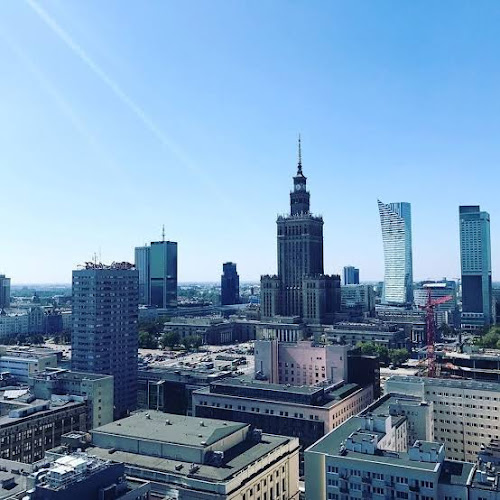
Hotel Warszawa occupies Warsaw’s former Prudential Building, a 1934 steel-framed skyscraper that remains one of the city’s most resonant architectural survivors. Now a five-star hotel, it preserves the tower’s modernist scale while using raw concrete, exposed steel, brass and walnut to create a deliberately industrial-chic interior. For visitors, it is as much a compact lesson in Warsaw’s twentieth-century history as it is a place to stay, dine or pause for a drink.
The building stands on plac Powstańców Warszawy in Śródmieście, between the cultural energy of Nowy Świat and the commercial core around Świętokrzyska. Its wartime story gives the address particular weight: the Prudential was heavily shelled during the 1944 Warsaw Uprising, and an image of the damaged tower became one of the defining photographs of the city’s destruction. A major restoration brought the building back into hotel use in 2018, retaining its hard-edged structural character rather than smoothing it away.
Standout Highlights & What Not to Miss
Non-guests can appreciate Hotel Warszawa most easily through its public spaces, restaurants and bar; it is not a conventional museum with a separate visitor route. Come with an eye for details, take time to look upward, and treat the building itself as the principal exhibit. The contrast between interwar ambition, wartime trauma and contemporary design is what makes a short stop worthwhile.
- The Prudential tower: Completed in 1934 to designs by Marcjan Weinfeld with engineer Stefan Bryła, the 66-metre building was once among Europe’s tallest. Its vertical form still reads as a bold interruption in the lower-rise streets around the square.
- Wartime context: Look for historical imagery and references in the public areas. Knowing that the tower was shelled during the Warsaw Uprising turns its preserved structure from a design gesture into a powerful historical document.
- Industrial material palette: Exposed riveted steel, concrete, brass and wood define the restoration. The best visual moments are often practical ones: stairways, corridors, lobby details and the meeting of old structural elements with new finishes.
- Upper-floor atmosphere: Guest rooms and suites are the fullest way to experience the building’s height and changing city outlooks. Visitors without a room should not expect access to accommodation floors simply for sightseeing.
- Food, cocktails and wellness: Two restaurants, a cocktail bar, an indoor pool and spa make this more than an architectural stop. The dining and bar spaces are the most natural public-facing reasons to linger.
- Art-led programming: The Hotel Warszawa Art Fair has used guest floors as gallery rooms, reinforcing the hotel’s role in the city’s contemporary cultural calendar when programming is on.
Visitor Strategy & Planning Snapshot
| Planning Factor | What to Expect | Practical Strategy |
|---|---|---|
| Ideal Arrival Window | Public areas are most enjoyable when they are not dominated by hotel arrivals, dining service or private events. | Build in a flexible daytime or early-evening stop; pair it with a meal or drink if you want a more settled visit. |
| Typical Time Needed | Non-guests generally need 1 to 2 hours to absorb the building, have a refreshment and explore accessible public spaces. | Allow extra time if combining dining, spa access where available, or an art event. |
| Booking / Queue Reality | Hotel access differs from access to its restaurants, bar, spa and event spaces. Popular dining periods and special programming can be busy. | Reserve dining in advance when it matters, and confirm arrangements directly with the relevant venue before making a special trip. |
| Terrain & Accessibility | The entrance is step-free and elevators serve all floors; adapted rooms are available on request. Public-area access may still vary with event layouts. | Visitors with specific mobility needs should contact the hotel ahead, especially for dining, wellness or event access. |
| Weather / Seasonal Fit | This is a strong all-weather stop, with most of its appeal indoors. The surrounding central streets work well in every season but feel different in rain, heat or winter. | Use it as a design-and-history pause between outdoor sights, particularly on cold or wet days. |
Honest Trade-Offs: Best For vs. Who Might Skip
This is an excellent fit for history-minded travelers, architecture fans, business visitors, couples planning a polished central stay, and anyone who values a hotel with a strong sense of place. It rewards close looking rather than checklist tourism. The trade-off is that much of the most compelling experience is tied to being a guest or using the hotel’s venues; there is no large standalone exhibition designed for drop-in visitors. Budget-focused travelers may prefer to admire the exterior and square, then spend their time on Warsaw’s public museums and memorials. Those seeking a quiet, residential atmosphere may also find the central business-and-cultural setting less relaxing than a neighborhood stay.
Neighborhood Context & How to Pair Your Visit
Hotel Warszawa fits neatly into a walkable central Warsaw itinerary. Start around plac Powstańców Warszawy and use the building as a lens on the city’s layered reconstruction, then head toward Nowy Świat for cafés, shops and the route north toward the Old Town. In the other direction, Świętokrzyska links you with the Palace of Culture and Science area and major transport connections. The nearby streets also make it easy to combine a brief architectural stop with museums, memorials or an evening meal. Rather than treating the hotel as a destination requiring half a day, use it as a richly textured anchor between larger sights: notice the tower outside, visit a public venue inside, and continue through Śródmieście with its history firmly in view.
When planning your Warsaw travel guide or comparing verified attractions and hotels in Warsaw, pair this stop with standout local spots including Maria Skłodowska-Curie Museum, Mamaison Hotel Le Regina Warsaw, Keret House, and Zapiecek (0.4 km away).


