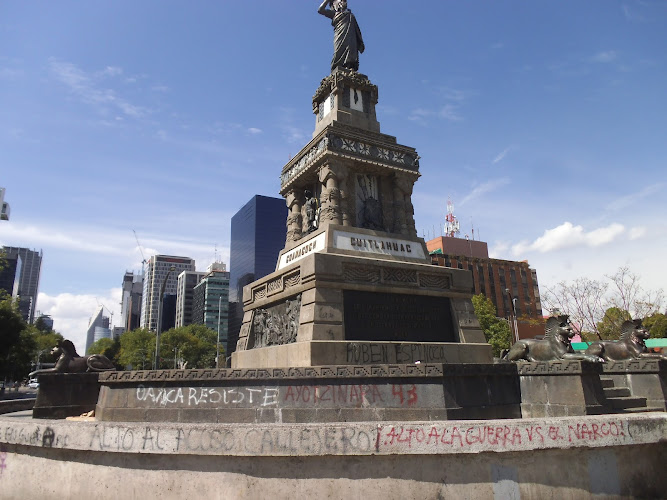
Monument to Cuauhtémoc is an outdoor 1887 civic monument at Av. Paseo de la Reforma S/N, Juárez, Cuauhtémoc, 06600 Mexico City, at the Reforma–Insurgentes junction. Dedicated to Cuauhtémoc, the final Mexica tlatoani of Tenochtitlan, it pairs a bronze imperial figure with an emphatically Indigenous pedestal and draws travelers interested in Mexico’s conquest-era history, nineteenth-century nation-building, and Reforma’s public sculpture.
What to Expect at Monument to Cuauhtémoc
The monument was inaugurated in 1887 during the Porfirio Díaz era, when Paseo de la Reforma was being shaped into a ceremonial boulevard of national memory. Architect Francisco M. Jiménez designed the composition, while sculptor Miguel Noreña created the bronze figure of Cuauhtémoc. Rather than a conventional European-style hero on a plain column, the work combines a tall stone base with pre-Hispanic visual language: stepped forms, geometric decoration, eagles, feathered motifs, and relief sculpture give the monument a deliberately Mexica character.
Look upward first at Cuauhtémoc, shown standing in martial regalia with a cloak, shield, and weaponry; the pose projects resolve rather than courtly elegance. Then circle the base slowly to read the sculptural program. Its bronze reliefs refer to the ruler’s capture and torture by Spanish forces after the fall of Tenochtitlan in 1521, episodes central to his place in Mexican historical memory. This is a monument to view rather than enter: there is no gallery, ticket desk, interior, guided-tour counter, café, or dedicated museum shop.
- Bronze Cuauhtémoc figure: Miguel Noreña’s statue presents the Mexica ruler in formal warrior dress above the busy Reforma traffic corridor.
- Indigenous-inspired pedestal: Stone ornament, stepped profiles, and symbolic motifs distinguish the monument from the boulevard’s more European neoclassical memorials.
- Conquest-era reliefs: Examine the lower sculptural scenes for references to Cuauhtémoc’s final resistance and imprisonment after 1521.
- 1887 national monument: The work belongs to the Porfirian remaking of Reforma as a route lined with monuments to Mexican history.
- Reforma architecture walk: Its position links the historic Juárez and Zona Rosa districts with the Ángel de la Independencia corridor.
Monument to Cuauhtémoc at a Glance
| Detail | Information |
|---|---|
| Address | Av. P.º de la Reforma S/N, Juárez, Cuauhtémoc, 06600 Cuauhtémoc, CDMX, Mexico |
| Neighborhood / Area | Juárez, beside Zona Rosa at the Paseo de la Reforma–Avenida de los Insurgentes junction |
| Operating Hours | Open 24 hours daily as an outdoor public monument; daylight is best for close viewing and photographs. |
| Admission / Price Range | Free; no ticket or reservation is required. |
| Recommended Visit Duration | 20 to 35 minutes; allow longer when combining it with a Reforma walk. |
| Nearest Transit / Parking | Metro Insurgentes on Line 1 is about a 10-minute walk; paid garages are available around Zona Rosa and Juárez, with no dedicated monument parking. |
| Official Website & Phone | No dedicated visitor website or public telephone line; it is an unrestricted public-space monument. |
Visiting Tips, Getting There & Nearby Pairings
Arrive early, ideally between 8 and 10 a.m., for clearer light, less pedestrian congestion, and a more comfortable look at the reliefs. The monument can be photographed at any hour, but Reforma’s vehicle traffic is constant and nighttime viewing is more about the illuminated boulevard than fine sculptural detail. There is no queue or timed entry. Stay on marked pedestrian routes and use signalized crossings; this is one of the city’s busiest intersections.
From Metro Insurgentes, walk west through the commercial streets around Zona Rosa toward Reforma. The site has public pavement and level viewing points, but the monument itself stands on a raised base with no interior or elevator; visitors using wheelchairs or strollers should approach from accessible curb ramps and expect uneven paving near the landscaped traffic island. Pair it with the Ángel de la Independencia, roughly a 10-minute walk west along Reforma, or walk east to the Glorieta de las Mujeres que Luchan. The cafés, restaurants, and galleries along Calle Hamburgo and Génova in Zona Rosa are also within 5 to 10 minutes on foot.
Frequently Asked Questions
What are the best hours to visit Monument to Cuauhtémoc?
The monument is accessible 24 hours a day because it stands in public space. Visit in the morning for photographs and safer, easier study of the pedestal’s details; evening is best if you are continuing along Reforma after dark.
Is there an admission fee or reservation requirement?
Admission is free and no reservation is needed. There is no ticket office, guided interior visit, or paid attraction component, so costs are limited to transportation, nearby parking, or food and drinks.
How long should I spend at the monument?
Budget 20 to 35 minutes to see the statue, inspect the reliefs, and photograph the architecture. Allow 1.5 to 2 hours if continuing on foot to the Ángel de la Independencia and through Zona Rosa.
Is Monument to Cuauhtémoc suitable for families and wheelchair users?
Families can make this a short, useful stop for discussing the fall of Tenochtitlan and Mexican national identity. Wheelchair users and strollers can view it from the surrounding public walkways, though the raised plinth is not enterable and crossing the broad, high-traffic intersection requires care.
When planning your Mexico City travel guide or comparing verified attractions and monument in Mexico City, pair this stop with standout local spots including Les Moustaches, Desierto de los Leones, The Angel of Independence, and Monumento a la Madre (0.2 km away).